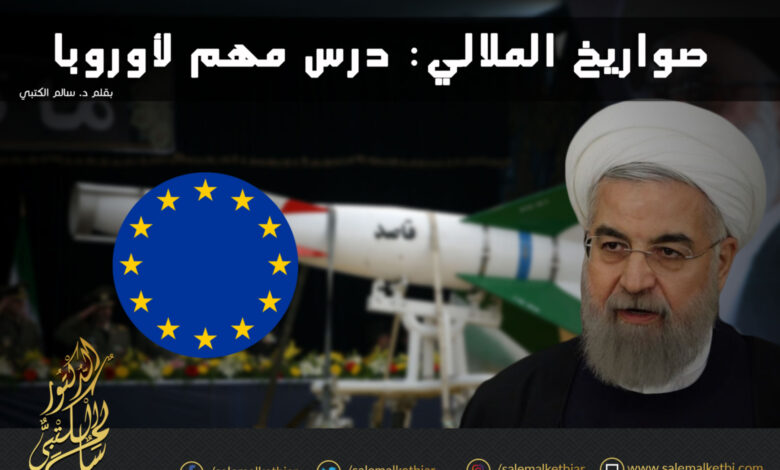
Although Iran’s recent test of a medium-range ballistic missile does not provide a new understanding of the mullahs’ behavior, it has important dimensions and connotations that EU countries need to understand.
Some might think at first sight that the missile test is a challenge to US sanctions, in response to President Trump’s decision to withdraw from the 5 + 1 nuclear deal with Iran, and then impose US sanctions that are described as the most severe of the kind against the Iranian regime. This interpretation represents one of the dimensions of this development, which reveals the narrow horizons of the Iranian mullahs and their absolute dependence on the policy of “brinkmanship” in the face of crises that threaten the regime.
The narrow-mindedness of Iran stems from the mullahs’ contempt for the EU position, which supports Iran in its stance on the nuclear deal. The simplest political rhetoric suggests that the missile test places Europe in a very sensitive and embarrassing position because it reveals the mullahs’ contempt for the position of the European partners, as they have not accurately valued the position of Europe, which has staked its Atlantic partnership with the United States to support the nuclear deal with Iran.
While Europe was still looking for a mechanism to continue exchanges and cooperation with Iran to circumvent US sanctions, the mullahs’ missile tests carried a message that Iranian missile tests were “continuing to defend he country and dissuade its opponents, ” said the spokesman of the Iranian army.
Admittedly, the message of the mullahs has reached Europe: the recently tested medium-range ballistic missile can carry nuclear warheads and reach large parts of the European continent, which makes it impossible for Europe to ignore a threat of this magnitude. UN Security Council Resolution 2231, which seeks building confidence between the international community and the Iranian regime, contains a series of specific commitments that the mullahs are expected to respect to demonstrate their good will and build confidence, including preventing any activity related to ballistic missiles designed to carry nuclear weapons.
The problem is that Iran’s arrogance was not limited to missile testing, but was preceded by an explicit threat to resume uranium enrichment at 20% unless Iran does not get economic benefits for the nuclear deal!
This hateful blackmail requires a pause on the part of Europe mainly because these actions do not take into account the position of the EU. The French reaction to the missile test referred to the violation of United Nations Resolution 2231 and confirmed Iran’s failure to comply with that resolution. The same position was adopted by Britain, which considered that this missile test was “threatening”, and the statement expressed Britain’s “determination” about the need to stop these tests. .
The mullahs do not understand the language of politics and move only if the danger is close to the foundations of their political system. Thus, the condemnation will not hold the attention of the mullahs, and Britain is expected to adopt a firm strategy vis-à-vis this country because silence will cost Europe much of its security, prestige and its international status.
I do not know how British Foreign Secretary Jeremy Hunt, in his recent remarks, said the nuclear deal “is the cornerstone of stability in the Middle East”. Will the situation remain the same in the light of the missile test and the resumption of the uranium enrichment process?!
The ball is still in Europe’s court and the Europeans must understand that the mullahs understand only what has to do with the future of their regime and do not react to any efforts to ensure regional and international security and stability unless they fear the risk of no longer staying in power. Otherwise, provocative practices, which never reflect the behavior of a State that respects its international obligations and commitments, will continue.