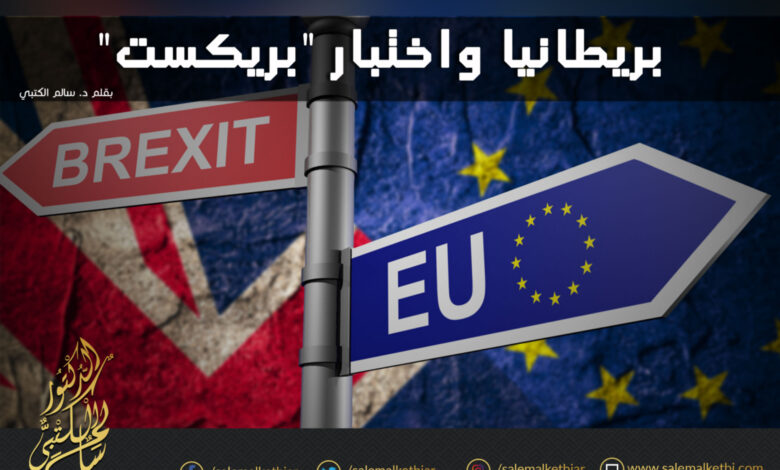
It is undeniable that Great Britain is currently facing a very difficult historical test concerning its exit from the European Union, the so-called Brexit. Although European leaders have recently approved the exit agreement at their last meeting in Brussels, the government of British Prime Minister Teresa May is still waiting for Parliament to ratify the agreement for it to take effect.
Admittedly, Britain has been in a state of political anxiety since the outcome of the referendum in which voters voted in 2016 in favor of the exit of the European Union, which should be officially implemented on March 29 2019.
The British are waiting until December to see the results of the vote on the agreement in parliament, where the chances of ratification are low, and the task of Teresa May in this regard is not easy at all, as some parties tend to vote against the agreement. The rejection is not limited to the Labor Party and some other parties. But some Conservative MPs are also planning to vote against the agreement, and the position of some Conservative MPs may have been the reason for May’s direct message to the British in support of her agreement to leave the EU. In her letter, she said that she would do her utmost to get the agreement accepted in the country Parliament, noting that “It will be a deal that is in our national interest – one that works for our whole country and all of our people, whether you voted ‘Leave’ or ‘Remain’, considering the agreement as the best possible formula between the two parties, Great Britain and the European Union.
In general, it is difficult to predict the effects of the exit of Britain, described by the President of the European Commission, John Claude Juncker before the last meeting of the leaders, as “a tragedy”. On the other hand, some Britons fear the consequences of the exit agreement, which the Sunday Telegraph saw in an article by Daniel Hannan,as authorizing the EU to destroy Britain. The author believes that the agreement is not a victory and represents only “the sort of deal that a country signs when it has lost a war. Under its terms, Britain will remain subject to all the costs and obligations of EU membership, but will give up its vote, its voice and its veto.”
Most disturbing are the consequences of the vote on the agreement by the British Parliament. All scenarios remain open, but the consequences are still largely unknown. In the event of a vote against the agreement, Great Britain would be absent on March 29 without agreement. This “ghost” scenario raises the concern of the British economic community, as it causes a sudden break with the UK’s closest trading partners, which would lead to confusion in the movement of goods, travel, financial markets and all forms of bilateral relations associated with Britain’s accession to the Union. And so the fear of a sudden chaos in the British economy paralyzes the thinking of many people, to the point that the Minister of Finance, Philip Hammond, has strongly warned that leaving the European Union, without reaching an agreement will have “serious repercussions and extremely disruptive and negative consequences for jobs and future prosperity in the British economy.
If the exit plan is rejected by the UK Parliament, the Prime Minister has the opportunity to return to Brussels to improve exit conditions to ensure access to parliamentary support for the agreement, which depends on the possibility of Consent of European leaders to return to negotiating conditions, The consequences of Britain’s exit without agreement, where the negative effects are reciprocal and not in a single way, therefore limit the possibility of return, and the media report alternative plans being prepared to replace the agreement, in whole or in part.
The most difficult scenario for Prime Minister Teresa Mai is the failure of the previous two, with the possibility of a return to negotiations with the European Union and the possibility of a third scenario resulting from the blocking of the solution, which would push the Conservative Party to overthrow May from party leadership. There is another scenario, that May herself call for general elections, which is also a strong hypothesis. There is also the hypothesis of asking for a new referendum on the exit from the European Union in the face of the growing rejection of the British, an assumption rejected by Teresa May, but which can be adopted if she is removed from the leadership of the conservative party.
The major problem is that these are catastrophic scenarios, or “black swan” scenarios, which are several more painful scenarios, but overall, several scenarios are waiting for Britain by the maturity of the parliamentary vote on the exit agreement from 10 December and until March 2019, However, in the foreseeable future, Britain will not return as it was before the end of 2016 referendum.