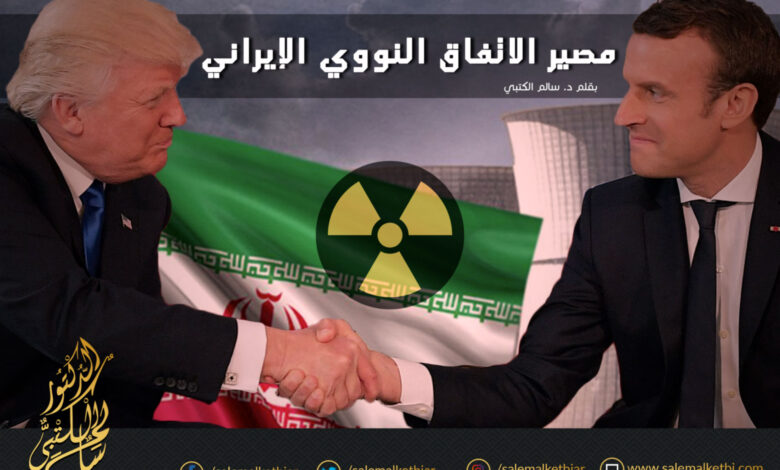
The world is about to hear Trump’s decision about the US withdrawal from the nuclear deal with Iran in less than two weeks. The Joint Comprehensive Plan of Action signed between Iran and the P5+1 has known speedy developments. The recent visits by Macron and Merkel to Washington focused on discussing attempts to make Trump keep the deal.
The Times has reported that Trump swayed Macron’s Thinking on Iran. The report assumed that US’ allies failed to convince Trump to change his position on the nuclear deal. The Times stressed that Macron’s visit to the US changed his point of view about Iran. According to the report, Trump said Macron “is viewing, I believe, Iran a lot differently than he did before he walked into the Oval Office.” Macron said that he expected Trump will withdraw from the deal “for domestic reasons” and will impose “very tough sanctions” on Iran. The same report stated that Macron went to Washington to convince Trump to keep the Iran nuclear deal. He suggested making new amendments to restrict Iran’s nuclear capabilities and its influence in the Middle East.
Macron said at the end of his visit that he expected Trump to withdraw from the 2015 agreement. The French president said he may have failed to persuade his US counterpart Donald Trump to keep the international nuclear deal with Iran.
The Nuclear Agreement was a top priority within the Macron visit program. He said he would work with Trump to build a “new framework” in the Middle East – and especially in Syria.
Merkel’s mission in the US has also failed to convince Trump to stick to the nuclear deal with Iran. She said she would keep contact with Trump over the deal. Obviously, Merkel, who spent only three hours in Washington, did not succeed to do what Macron did not triumph to do in three days. Macron’s visit was the first State visit by a foreign leader to the US under the Trump administration. She delivered a speech at the Congress, a speech that was met with a remarkable ovation from Trump and the Congress members.
Trump did not appear to change his position under the pressure of his allies. He succeeded to change their point of view on Iran. Merkel said “We had an exchange of views. The decision lies with the president.”
These visits showed the consensus of the Western countries signatory to the agreement to contain the Iranian influence. The UK, France and Germany believe this could be achieved through amending the deal. And Trump sees that tearing up the deal will contain Tehran’s influence. Germany refuses Iran’s development of ballistic missiles, stressing the need to curb its influence in the Middle East.
Europe’s stance stems from the absence of an alternative that could replace the current agreement. The EU is highly concerned about Iran’s threats to resume its nuclear program if the US withdraws from the deal. The EU seems to be under the influence of the psychological campaign launched by the mullahs to intimidate the West from the consequences of the US pullout. Tehran wants to push European leaders to pressure Trump to change his position.
Newly confirmed Secretary of State Mike Pompeo said president Trump has not yet made a decision on the agreement. “Absent a substantial fix, absent overcoming the shortcomings, the flaws of the deal, he is unlikely to stay in that deal,” he added. The US State Department said in a statement that the US does not intend to review nor cancel the nuclear deal but seeks to fix its loopholes.
The French president told the Congress that the policy towards Iran should not lead to war but should guarantee the sovereignty of States, including Iran itself. “Let us not commit new wars,” he said. Referring to the deal, Macron said “We should not abandon it without having something substantial and more substantial instead. That’s why France will not leave the JCPOA, because we signed it.” He added that work should be done to achieve a more comprehensive agreement that includes four main points: preserving the content of the current agreement, covering the period beyond 2015 (after the end of the current agreement), containing the military influence of the Iranian regime in the Middle East, and monitoring the Iranian ballistic missile program.
The UK has expressed a similar view, adding that the nuclear agreement was the result of negotiations that lasted 13 years. The deal should not be sacrificed without an effective alternative. “I don’t think anybody has so far produced a better alternative” to the agreement, said British Foreign Minister Boris Johnson. “We accept that Iranian behavior has been disruptive in the region, we accept the president has some valid points that need to be addressed, but we believe they are capable of being addressed inside the deal,” he added.
Germany is persistent, among the European tripartite, to maintain the nuclear agreement. But the views of the three countries are very close and it is difficult to say that there is a divergence among them.
Given this status quo, an important question arises: What is the fate of the nuclear agreement?
Trump’s approach makes it difficult to identify his decision before May 12. Speculations here seem to be unsafe. Trump seems to be using the policy of the edge of the abyss in managing crises. He escalated in several issues and then soon found the justification to abandon all his escalations. Dealing with the North Korean file, Trump shifted from waving the nuclear button to a potential historic summit. In Syria, he moved from the threat of a devastating blow to a very limited strike in which the US was keen to avoid collision with Russian troops. Trump seems convinced that he did not give up his positions or made concessions. This is the case with the nuclear deal. He is likely to adopt the point of view of the three European countries. China and Russia also reject his pullout from the agreement. Trump will tighten pressure on Iran in the next few days. His team will be working to find a formula that meets Trump’s position (withdrawal from the deal) and the European trio’s stance (amendment of the deal). Trump will promote his decision as a translation of his announcement of tearing up the nuclear deal.