Tehran’s military presence in Syria is a source of concern for the world. Iran has become a threat for regional security. The mullahs are keen to carry on their regional expansion.
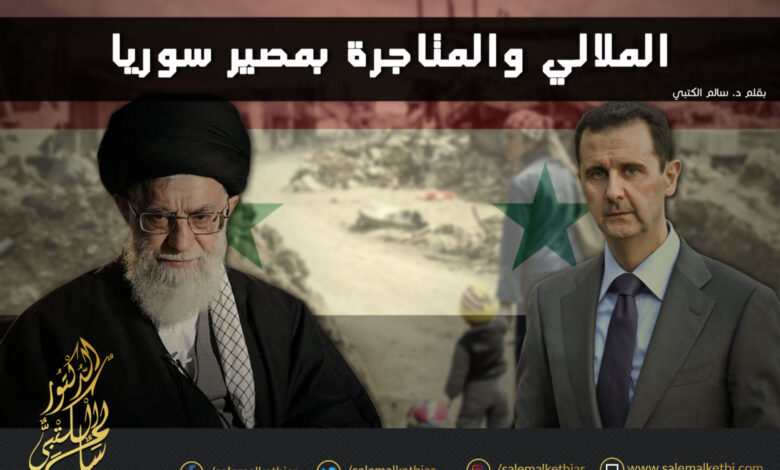
In his comment on the downing of the Israeli F-16 jet, Mohammad Ali, member of Iran’s Expediency Council, said that Bashar al-Assad was about to leave power in the early stages of the Syrian crisis, but he retracted his position after a meeting with General Sardar Hamdani. Mohammad Ali confirmed that Hamadani told al-Assad not to worry if 10,000 weapons were distributed to people and that this would eliminate the danger. Ali pointed out that the General Sardar mobilized 80,000 Syrians and brought Hezbollah into the scene making the Syrian army stronger. Today, the Syrian army is able to drop a Zionist plane.
Al-Assad is indebted to Tehran and won’t ask the Revolutionary Guard to leave Syria. Iran’s militias are making al-Assad regime weak by inciting tensions with Israel. Iranian jets without pilot have been crossing the Israeli airspace in a new plan to wage a new proxy war and make the Syrian people pay the price.
Iran is aware of the international efforts to eradicate its influence in the Middle East. Tehran wants to prove its political weight by mixing cards and implementing a strategy of confusion. The mullahs are trying to incite a new war in Syria and confuse regional balance of powers to postpone any plan to chase Iran out of Syria.
The mullahs don’t care about the prices paid by the people of the region. Sectarian organizations have an upside-down understanding of victory. The Lebanese Hezbollah celebrated their shameful victory in 2006, despite the massive destruction and losses.
The Revolutionary Guards want to prompt and wage a proxy war against Israel. Tehran seeks to preserve its military and nuclear facilities against any Israeli attack. The strategic calculations prove that proxy war is less costly to Iran. The mullahs are working hard to chose the battlefield and prevent Iran from a sudden military strike.
Tehran seeks to establish a military base in Syria. Reports talked about the establishment of a factory to produce missiles and military equipment for the Lebanese Hezbollah on Syrian territory. This has not gone unnoticed, especially by Israel. Benjamin Netanyahu, Israel’s PM, said that Israel won’t allow this to happen. But the mullahs still carry on their plans without caring about Syria’s fate.
Is this a new stage in the conflict with Israel after the downing of the F-16 jet? This analysis lacks reason.
The balance of power in the region has not been disrupted. The Syrian airspace is still open to Israeli aviation and nothing changed after the downing of the Israeli jet. Secrets behind the Israeli jet crash may soon be revealed.
Tehran is still using Syria and its people to achieve its goals. The Syrian people don’t need new wars. They are still suffering because of the terrorist organizations and foreign interventions.
It has no sense that the mullahs continue their tactical media exploitation of Syria under the pretext of alleged victories. Iran is the primary stakeholder in destroying what is left of Syria. Tehran seeks to ignite a new war and carry on its expansionist plans.