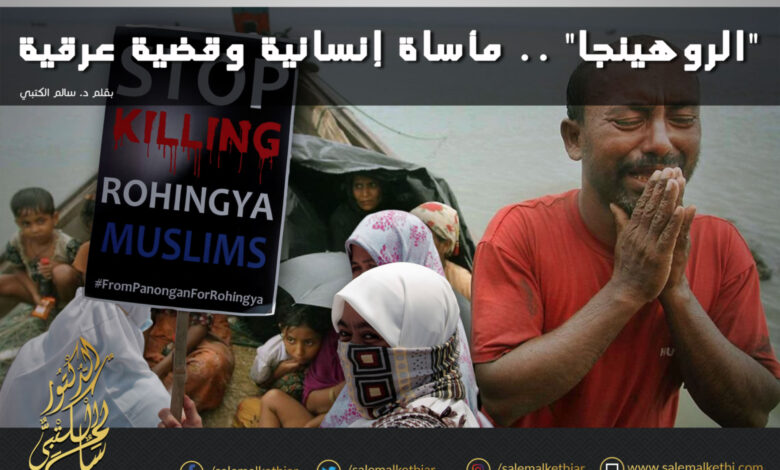
The atrocities and massacres of the Rohingya Muslims has been a major public opinion concern in Arab and Islamic countries lately. For fear of violence against them in Myanmar, people are increasingly fleeing to bordering Bangladesh. Myanmar seems to have taken advantage of the global atmosphere fraught with many international tensions to implement its plans for the Muslim minority there.
The Myanmar authorities have not provided the world with convincing evidence so far to deny violations against the Rohingya Muslims. Rather, they only talk about “media exaggeration”. Official and media reports point to a human tragedy and a terrible disaster on the border with Bangladesh. Ms. Aung San Suu Kyi, the State Counselor, found herself in an extremely embarrassing position when she has failed to stop violations and massacres, despite being a Nobel Peace Prize winner for her efforts to bring peace to her people and fight against dictatorship.
Aung San Suu Kyi had long fought a long political struggle against the country’s dictatorial regime. She had been in solitary confinement and house arrest for many years. So she is supposed to reject ethnoreligious persecution. But violence against Rohingya Muslims is something she chose to ignore, although she herself had suffered from persecution and repression by the dictatorship in Myanmar. When she won the election, she did nothing to stop ethnic cleansing, specifically against the Rohingya minority, by the Buddhist majority that she belongs to. Instead, she turned her back on human rights when she could have prevented another genocide the State will be stigmatized with for a long time.
Aung San is the State Counselor of Myanmar, the equivalent to Prime Minister, and the fact she denies the genocide and has repeatedly told the press the Rohingya are not Burmese citizens poses a serious moral dilemma. She has also refused to condemn the systematic violence against them and justified it with nonsense excuses in clear display of in-group favorism.
The Burmese leader has failed to address the most complex issue in her country, that of more than a million Muslims who have been stripped of their citizenship. Moreover, she did nothing to rein Ma Ba Tha, a Buddhist exterminationist Nazi-like organization.
Aung San’s silence about the persecution of the Rohingya, which represents about 4% of the population, surprised even the Dalai Lama, the Buddhist spiritual leader.
Some attributed her weakness to the influence of the military, whose rule officially ended in 2011 but which still exert power in government. The military apparatus holds 25 percent of the seats in the parliament and important ministerial portfolios, including the army, the police and borders control, aside from its dominance over national security affairs.
Some analysts have rather interpreted her reluctance to face the military’s influence on the Rohingya in light of her current constitutional status. Although she is the leader of the overwhelmingly winning party, she cannot actually head the State. She married a foreigner who died in 1999, and the 2008 constitution prohibits any Burmese citizen who is married to a foreigner from being the president. But Aung San is hugely popular so she can actually deal with sensitive ethnic issues if she wanted. She even said herself she can run the country from a “super-president position.” Although Myanmar’s head of State is Htin Kyaw, the president since March 2016, who has led the post-military rule first democratically elected government after Aung San was constitutionally prevented from running for president, she has the whip hand in the State. She has enough popular and partisan support to make the president her right arm, as she said. Overall, as far as human rights are concerned, now we are witnessing the flip side of Aung San’s leadership.
Although she is constitutionally prohibited from taking power, she is the actual leader of the party in power. In fact, The Daily Telegraph said she is the “de facto leader” in Myanmar and has enough authority as well as influence to call on citizens to end the massacre of Rohingya Muslims.
The Rohingya massacre does not have religious motives but ethnic ones. The Arab and Muslim world should think of it as an unfortunate ethnocide and not just a Muslim minority issue, since most Rohingyas are deprived of their right to citizenship. Christians in Kachin and Caren States have also been fighting for rights and equality since independence, as The Telegraph notes.
Politicians and journalists too should treat this human tragedy from an ethnic angle, a massacre that violates many international law agreements including The Universal Declaration of Human Rights (1948), the Convention on the Prevention and Punishment of the Crime of Genocide (1948), the International Covenant on Civil and Political Rights (1966) and the Convention against Torture and Other Cruel, Inhuman or Degrading Treatment or Punishment (1948).