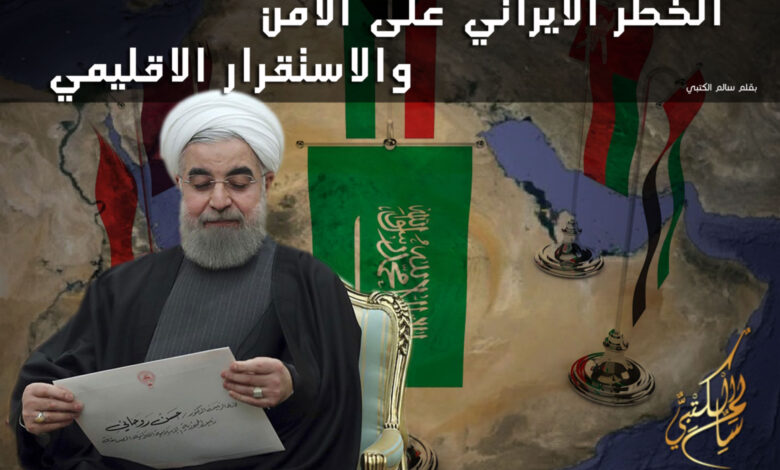
During a recent business trip, someone asked me: Why do you think Iran is a danger to the Gulf? I said that I have wrote, like many others, about the aspects of madness and absurd practices of the mullahs’ regime. It is indisputable that Iran neglects international laws, norms and conventions. The Iranian risk deserves more focus. Understanding the threat requires realizing the limits and aspects of this danger.
In this article I try to keep track of these aspects. The first aspect is the Iranian pursuit to impose a strategic siege on the GCC countries through the expansion of Iranian influence in countries such as Syria, Iraq, Lebanon, and Yemen. This expansion is accomplished by Iran’s proxies such as the Lebanese Hezbollah, the Shiite Mobilization and Al-Houthi group. Furthermore, financing anti-State groups in Bahrain and the situation of Shiites in Eastern Saudi Arabia are other aspects of Iranian expansion. Iran also extends its influence over the African region and other influential countries in Gulf national security such as Pakistan, Afghanistan and some African countries.
The second aspect is the use of economic incomes from the nuclear deal that was signed between Iran and major powers. Most of the income was used for financing Iran’s sectarian expansion. The third aspect of this threat is the Revolutionary Guard’ management of Iran’s regional relations and sectarian hostile attitudes against the Gulf and Arabs. Gen. Qassem Soleimani, commander of the Revolutionary Guard, acts as an official military adviser to the Iraqi government. Consequently, Soleimani made frequent interferences in Iraq and Syria.
The fourth aspect is the implementation of ethnic cleansing operations. These operations aim to demographically change cities in Iraq and Syria that were freed from ISIS. The Shiites who were displaced from Pakistan, Afghanistan, Iran and Iraq would replace the indigenous population living in these freed cities. Iran plans to cause division in Iraq and Syria in order to change the balance of regional power to serve its interest. Fifth, Iran is seeking in various ways to put pressure on Saudi Arabia, a national security pillar of the GCC countries. Iran’s schemes against Saudi Arabia take different patterns such as the political employment of religious rites and the implementation of sedition during the Hajj season when about 3 million Muslims visit Mecca and Medina. The mullahs also want to undermine Saudi Arabia’s efforts in organizing the pilgrimage through calls on the internationalization of the management of the holy sites. They incite conflicts in the Kingdom, one of which had led to the killing of hundreds of pilgrims during the last pilgrimage season, in an attempt to question the level of security in the KSA.
The sixth aspect of the Iranian threat is the occupation of the three UAE islands, namely Great Tunb, Small Tunb and Abu Musa. Iran refuses any proposal of peaceful settlement that the UAE offers at various events and forums, reflecting the Iranian determination to impose the occupation. Although there are historical documents that prove the ownership of these islands by the UAE, Iranian occupation continues. The regime recently claimed the islands Zirco and Ariana belonged to Iran. Nothing could be further from the truth. This position reflects the radical recklessness of the Iranian conduct.
The seventh aspect lies in Iran’s powerful media of dozens of satellite channels, newspapers, websites and electronic armies responsible for sectarian incitement and undermining the foundations of regional security and stability.
The eighth aspect is that, from time to time, the mullahs’ regime maneuvers and demonstrates military power in the Gulf waters. This seems to be a clear and deliberate threat to neighboring countries regardless of any claims about seeking regional security and stability. Furthermore, Iran’s development of rocket systems puts the GCC in danger. Most of these systems are short-range and capable of reaching cities in GCC countries.
In addition, there is an ideological sectarian threat under enticing slogans to mobilize the Shiite community in the GCC countries to serve the Iranian project. They try to undermine the loyalty of these citizens to their countries through various sectarian schemes. The mullahs seek to provoke social conflict in the GCC countries so as to put pressure on these strategic countries. There is also a security threat that depends on paramilitary entities made up of sectarian and Shiite militias in countries such as Iraq. Iran also funds proxies such as Al-Houthi group in Yemen, Hezbollah in Lebanon and other organizations that receive orders from Iran’s Supreme Leader. These organizations carry out instructions conveyed by the commanders of the Revolutionary Guard. There is also an exploitation of Sunni terrorist groups in the implementation of the planned expansion of Iran, through financing these groups and hosting their leaders. Iran uses these groups as an excuse to interfere in the Sunni neighboring countries in order to keep the Shiite people safe. There is also a strategic economic threat since Iran continues threatening to close the Strait of Hormuz. Ships that carry out exports of Gulf oil, which pass through Hormuz Strait, are also subject to Iranian threat.