Young people are the password to the success of development strategies and to building the future of states and nations. They are the future energy stocks, which deserve the care and attention of leaders and governments. Tomorrow cannot be viewed with optimism without a good preparation of these vital strategic reserves. These bases are a firm conviction among the leadership in the United Arab Emirates, led by His Highness Sheikh Khalifa bin Zayed Al Nahyan, may God protect him.
What is certain is that this conviction is implemented in the overall state policies and strategic plans, and any observer can make sure of the translation of this conviction in the various labor and production areas, full of young Emiratis giving hope in a better tomorrow for the future of our young State.
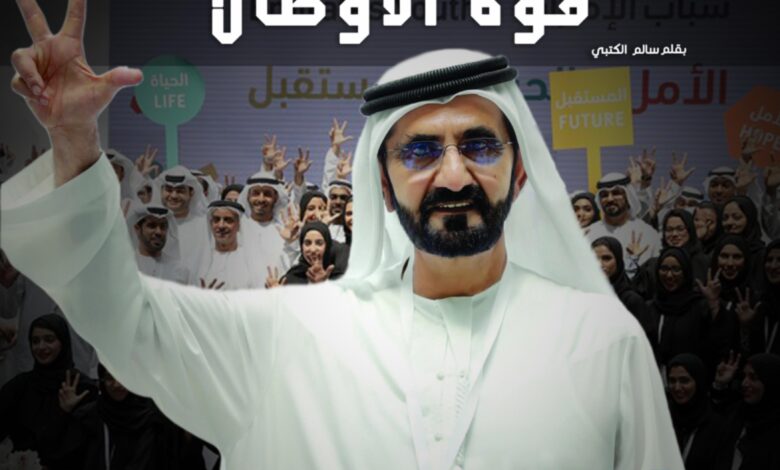
Yesterday, the State of the Emirates launched the National Agenda for the Youth. His Highness Sheikh Mohammed bin Rashid Al Maktoum, UAE Vice President and Prime Minister and Ruler of Dubai, May Allah protect him, stressed in the celebration of this occasion that young people are the strength of the homeland and its hope to build a better tomorrow. They build the future through their abilities and skills. And through their efforts, they accomplish progress towards a prosperous tomorrow for current and future generations.
Everyone knows that the UAE is rich with natural resources of fossil energy and other resources. However, our wise leadership shows exceptional interest in a stock of sustainable energy, which enhances the value of natural resources and wealth, and is the cornerstone of today and tomorrow. This stock is the youth, the lively and vibrant heart of the state, as His Highness Sheikh Mohammed bin Rashid Al Maktoum said in his speech on the occasion.
Because since its inception in the second of December 1971, the UAE has been aware of the fact that interest in the youth does not come through words and statements, but must be translated into plans and policies to be implemented, young people were always the center of attention. There are successive achievements aimed at enhancing the competitiveness of UAE youth at the level of education, training and qualification for the labor market, so as to ensure the maximum possible opportunities for our young people in terms of creativity, innovation and leadership.
Recently, the UAE launched a national dialogue and a retreat for young people, so that the youth take the initiative and think about their future and the future of their nation and plan for it. Empowerment in the UAE is not a mere slogan, but deliberate strategic plans that contribute to building a better future for our future generations. The youth of the UAE are the hope and the real wealth of the country, and they are the real stake as said by His Highness Sheikh Mohammed bin Zayed Al Nahyan, Crown Prince of Abu Dhabi and Deputy Supreme Commander of the Armed Forces may God protect him, on the occasion of World Youth Day during the month of August. He said that with the will and the spirit of the youth, full of ambition and optimism and a sense of belonging, we will make the UAE, with God’s help, reach new heights of leadership and excellence.
These words confirm the extent of the confidence and hope of our wise leadership in the youth, so there are successive initiatives and plans to build this youth intellectually and culturally, and to refine their experiences and skills so as to enhance their capacity to shoulder the responsibilities of tomorrow.
One of the most important attributes of the UAE’s strategy on youth lies, from my point of view, in the strong link between identity and national cultural specificity on the one hand, and planning for the future, on the other hand. Our thinking for the future stems from the present and is based on authentic identity values, which confer on our developmental experience a qualitative uniqueness among other international experiences.
This evident attention to the youth is what is needed by all Arab countries without exception, not only because the youth are the largest age group of the population in these various countries, but because ignoring them means disregard for the future, which in itself is a developmental and planning problematic presenting tremendous dangers to the future of the countries that suffer such dilemmas.
It is certain that this interest is doubly important in light of several considerations. First, the sweeping incursion of globalization at the economic, social and cultural levels, and its huge potential to influence the youth trends by virtue of their being the age group that interacts the most with globalization applications and its manifestations in the areas of communication and social media and other areas, and therefore they are the most vulnerable to this phenomenon. Second, young people are the most able to compete, therefore, they are the basis for global competitiveness at the level of development in the Twenty First Century. Third, the youth are the most targeted by the most dangerous strategic threats in the Twenty First Century, most notably terrorism and extremism organizations, which seek to infiltrate the youth through a variety of communication and media and cultural means. Hence, fortifying the youth and promoting awareness, loyalty and patriotism among this segment is like an immunization for the future of the entire nation, and a protection against the conspiracy of conspirators and haters.