It seems that Iran is no longer interested in the regional and international responses about its practices, which do not comply with international law and norms. The last of those acts is what was recently reported in the statements of Iranian Navy Commander, Brigadier General Ali Fadavi, to Iranian media, in which he boasted that his troops trained foreign elements in Varur Island near the occupied three UAE islands (Greater Tunb, Lesser Tunb and Abu Musa) in the Arabian Gulf waters.
What is certain is that the explicit recognition of the location of the exercises reflects the size of the Iranian conspiracy hatched against all the countries of the region. Bringing mercenaries among Shiite fighters from countries such as Pakistan and Afghan Hazara refugees in Iran and others, represents a qualitative development in the violations of international laws by Iran, and reveals the indifference of Iran towards its blatant sponsoring and support of terrorism in front of the eyes of the international community.
There is no doubt that the Iranian official announcement of these militias is not surprising. The Revolutionary Guards General Mohammad Ali Jafari has already announced in mid-January that his forces have two hundred thousand fighters in five countries in the region who support what he called “the resistance and resilience approach”. And if we add to this the statements of the former commander of the Revolutionary Guards, Brigadier General Mohsen Rafiq Dost, which revealed the intention of the Iranian Revolutionary Guard to found the Iraqi Revolutionary Guards, as he said, “the Revolutionary Guard are ready to invest all their energy to help Iraqis establish a Revolutionary Guard in Iraq.”, adding that the Revolutionary Guards will use all the experiences of their founding to assist in the establishment of the Iraqi Revolutionary Guards, claiming that the Revolutionary Guard is “an adequate model” for the countries in the region, we would realize the seriousness of the plot carried out by Iran to dominate and implement its sectarian expansionist project in the region.
These statements and others confirm the existence of a subversive Iranian regional project, and were it not for the Arab military coalition intervention in Yemen, the region would now have another face, since Tehran was seeking to complete the strategic siege and the strangulation of the GCC states north and south, but the crucial decision of the Saudi leadership has prevented Iran’s implementation of the plan.
What everyone should notice is that Iran is mating between the plans of spreading Shi’ism on the one hand, and the sectarian military recruitment on the other hand, according to a deep strategic planning aimed at consecrating Iranian regional hegemony and countering the influence of Saudi Arabia, which seeks to preserve the security and stability of the Gulf Cooperation Council countries in the face of the ugly Iranian sectarian encroachment.
If the Daash organization has expanded the terrorism circle in the Middle East, Iran is working to institutionalize this phenomenon, and is following the footsteps of Daash in bringing Shiite terrorists from all over the world. Since 2013, Iran began to draw on Shiite fighters from the Afghan Hazara refugees in Iran, and also to draw on Shiite fighters from other Muslim countries, as media reports confirmed the killing of Pakistani Shiite fighters in Iraq and Syria during the past two years.
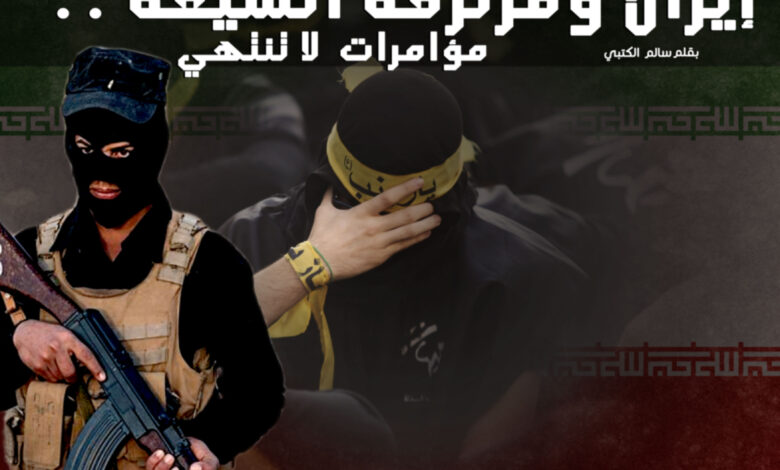
What is certain is that Iran has played on the impact and the strength of the economic factor in the expansion of attracting Shiite mercenaries from poor areas in Afghanistan and some other Islamic countries, which suffer economic difficulties and poverty that push many of its sons to join the ranks of the Shiite militias declared by Iran, as happens in the “Zeinbion” Brigade, which is extensively referred to in to media reports.
In its Shiite plan, Iran relies on the construction of a new vital area that includes what Tehran media calls the new axis of defiance, using to this purpose formal and informal means and mechanisms, and this is a vital topic in Iran, to the extent that the Shura Council had discussed last July an amendment to the Iranian nationality law, to allow the granting of Iranian nationality to fighters and intelligence collaborators from foreign nationalities, who are fighting and spying for Tehran’s projects in the world, especially loyalists in the Middle East.
The center of the Iranian parliament Studies website, according to what was published by the website of the Al-Arabiya channel, classified the groups covered by the amendment to the Iranian Civil Code, to four varieties, they are fighters and non-Iranian Mujahideen or foreign militias affiliated to Iran, and non-Iranian people wounded in wars, and the families of the non-Iranian dead, and the non-Iranian elites cooperating with the Iranian intelligence services.
This decision gives the authority to grant Iranian citizenship to Iranian security and military and intelligence services, a development that is very dangerous and that has a great impact on security and stability in the Gulf cooperation Council countries and the rest of the countries where Shiism is spreading.
Followers and specialists of the Iranian affairs realize that the recent Iranian statements are only uncovering the conspiratorial scheme already existing for years, and the American expert Ray Takia has already talked about it when he mentioned that Iran is seeking to form a rapid military intervention militia of nearly a million fighters so that it has the capacity to intervene in crisis areas in its geostrategic environment, and that the beginnings of the formation of these militias will consist of 200 thousand fighters deployed from Iran to Lebanon.
What is happening in Iraq is a manifestation of the worsening Iranian threat. After the announcement by the Iraqi Foreign Minister Ibrahim al-Jaafari of the appointment of General Qasem Soleimani as a military adviser to Iraqi Prime Minister Haider al-Abadi, Tehran has recently announced the appointment of General Soleimani as a military coordinator of Iran’s relations with Syria and Iraq, which means that there is a trend to perpetuate the Iranian military presence in these two Arab countries. It is likely that what is going on behind the scenes is the implementation of the Iranian orientation linked to the establishment of the Iraqi Revolutionary Guards along the lines of the Iranian Revolutionary Guard, so as to convert the existing Shiite Popular Mobilization forces into a semi-regular army parallel to the Iraqi army, as it is the case in Iran.
A few days ago, the American Republican senator Tom Katen said that “among the results of the nuclear deal with Iran is the increase of the boldness of Iran in continuing its terrorist actions all over the world,” and this is a very important statement because it reflects the reality that the current US administration ignores, as it is betting on a change in Iran’s behavior, while it is fully aware of the failure of its bets, but President Obama is still clinging to the illusion of the Iranian file.
Iran’s case is quite similar to the case of North Korea. The United States signed so many agreements and reached understandings with Pyongyang over its nuclear program, but because the North Korean regime is out of date like the mullahs’ regime in Iran, it did not commit to any agreement, and still clings to the Iron Curtain policy that fell in the former communist bloc.
It is clear that Iran’s efforts in terms of attracting Shiite fighters from several countries do not enjoy any Western media attention for the simple reason that the recruitment and subsequent fallout does not interest the major capitals, they turn a blind eye primarily from Iran’s terrorist activities aiming at devouring parts of Iraq and Syria, so how can they talk about the use of Shiite mercenaries, brought over from this or that country, to deepen the conflict and bickering and rancor and discord, and to expand the sectarian strife circle.