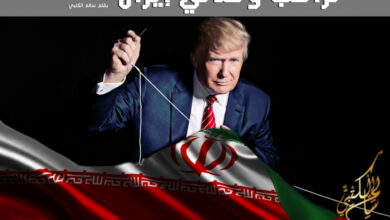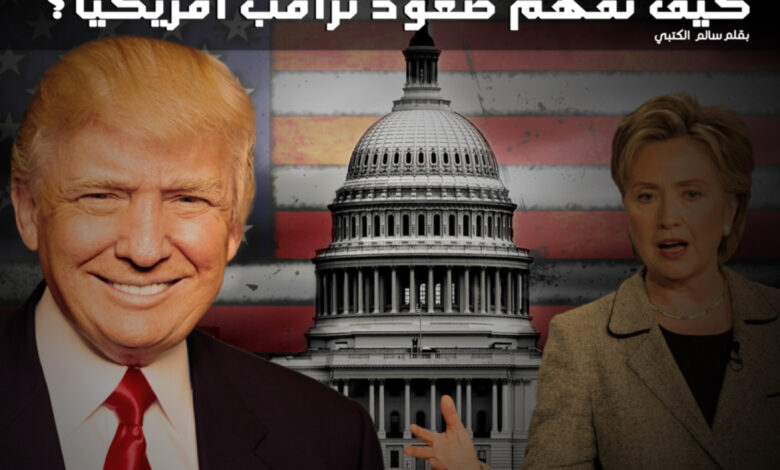
Within the US and the global debate about the remarkable political rise of the Republican presidential candidate Donald Trump, there are some absent points in the midst of the strong focus on the attitudes and opinions of the businessman seeking the Chair of the American presidency. Among the most prominent of these points is what is behind these trends and whether they do express a transient phenomenon in American politics, or reflect a return to the isolationist approach rooted in American history? Among these points also is the future of the phenomenon of globalization and the American cultural values that are reflected in the “McDonaldization” and “Cocalization” and other orientations that targeted the “molding” of global culture, and its modeling and “Americanizing”. Then how can we understand the phenomenon of the political ascent of the Republican candidate Donald Trump in contrast with the majority of expectations, which considered him as a “political clown” at the beginning of the election campaign?
Personally, I am very surprised at those who believe that the views of Trump are shocking and contrary to the American foreign policy prevailing for decades, despite the fact that some of these persons accused the current US President Barack Obama’s in the recent past of pursuing a withdrawal policy in Syria and the Gulf region, a charge that does not differ from reality nor contradict it, but means that the conflict between the notions of engagement and isolation exists and is heated between US foreign policy makers over the last years, particularly since the wars in Afghanistan and Iraq, and the human and economic losses they caused to the United States of America. The proponents of this view also ignore the fact that Trump was not alone in the arena of debate about the future of American politics, there was also the Democratic candidate Bernie Sanders, who is expected to be chosen as deputy for Democratic candidate Hillary Clinton in the fierce race toward the White House, after the decrease of his chances of winning the candidacy of the Democratic party in the face of Clinton, and after his hinting recently to the possibility of accepting candidacy for the office of Vice President in the event of his being chosen by the Democratic candidate who is most likely to win. Despite the complete disharmony of Sanders with Trump’s economic trends, he is the democratic version of Trump in terms of foreign policy, according to what is suggested by his political views and orientations, but with a difference regarding the pattern of thinking and the intensity of expression of ideas. He classifies himself as a social democrat in a capitalist country, even the capitalism Castle, which has for long fought in cold conflicts that ended with the overthrowing of socialist and communist regimes in the last century, so the views of Sanders strongly countertrend the neoliberal American movement, which began with the presidency of Ronald Reagan in the eighties, reducing the role of governments in controlling the markets, encouraging the idea of market liberalization and promoting competition, which many experts believe it has evolved into the financial crisis that occurred in 2008. In terms of foreign policy, we find that Sanders favors a prudent approach over experience, and he adopts the Obama administration’s positions and defends them vigorously. He is a fierce opponent of wars and considers armed force a second option in almost all cases. Although Sanders is no longer leading the presidential elections race as a Democrat candidate, the echo of his ideas will resonate in the circles of American political debate in the coming years, especially if he is chosen as deputy to Hillary Clinton. Additionally, his being supported by a large segment of young Democrats draws attention to important aspects of American thinking patterns currently prevailing.
Certainly, there are ongoing rapid changes in the American orientations at the economic and political levels. There is an increasing tendency to follow the example of the Scandinavian economic model, which combines socialism and neoliberalism, and strives to reduce capitalist brutality. The important matter within this worsening controversy, is the future of globalization, and whether it will proceed in accordance with its current system, or fall under the weight of the decline of the American momentum? The issue in this context is that globalization is closely linked to the idea of American supremacy, and the desire for the globalization of the economic and cultural model, and here comes the dilemma. In fact, the doubts surrounding the model from within would inevitably impact the attempts to its worldwide diffusion, as American values will face internal challenges as well as the external ones they face from the states and forces that put into question the ideal aspect of these values and their usefulness to mankind. One of the entrances of globalization is America’s self-power, which lies, since the beginning of the controlling of the global system, in the integrative power of the model, from culture to arts to industry, economy and freedoms, human rights and so on. But this power has always undergone the conflict between the two currents of isolationism on the one hand, and leadership in American foreign policy on the other hand, and the American history witnessed several intervals of ebb and flow at this level. The sixth US President John Quincy Adams (1825 – 1829), reflected this conflict when he said in the face of the advocates of intervention in the Greek war for independence, “America does not go abroad in search of monsters to destroy.” And then, the fate of globalization and its tracks seem under this controversy to a large extent.
We should also pay attention to the fact that Trump or another person’s ideas are not an executable blank check. There are legislative institutions and constitutional and legal constraints that might make a lot of these ideas just ink on paper. The military spending, for example, is among the issues that top the concerns of Republicans in both the White House and Congress, and then the talk of Trump about insularity and construction of border fences and the expulsion of foreigners, seems a kind of political imagination, and there are several warnings from American strategic experts who believe that isolationistic tendencies are detrimental to US national security, and destroy American historical investments in building alliances.
To understand what is coming at the US level more accurately, we have to differentiate terminologically between the concepts of extremism and austerity in American foreign policy. The two concepts are linked to the trends of current foreign policy and perhaps the future one. What President Obama follows is in fact austerity policy at the level of military interventions, which is also the product of scientific discussions about the feasibility of the soft and hard powers, which discussions have resulted in the “smart power” mix, where the focus is on setting goals and means carefully before choosing outside interference. Obama may not be the first American president on the path of austerity in the employment and rationalization of military force, as he was preceded by many other presidents including Nixon, Eisenhower and Carter. I think the foreseeable future at least will not see an American isolation or involvement in international crises and issues, but rather a continuation of a balanced approach between the notions of isolation and leadership, in a way that ensures the continuation of US control of the global system with minimal economic cost and military and strategic burdens, which are matters that we, as Arabs, must deal with realistically, instead of waiting for the successive changes in the White House.