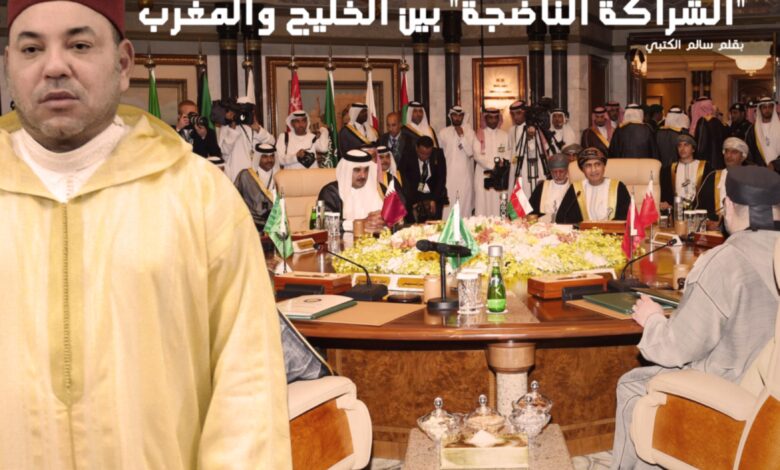
In the beginning, we have to assign credit to the ones deserving it in the concept of a “mature partnership”, as an innovative concept to refer to the evolution in the strategic relations between the Arab States of the Gulf Cooperation Council on the one hand, and the brotherly Moroccan Kingdom on the other hand. This concept is stated implicitly in the words of His Majesty King Mohammed VI, may Allah protect him, within the opening keynote speech at the GCC-Morocco summit, which was held in Riyadh recently. His Majesty stressed, “We meet today to give a strong impetus to the partnership, which reached a degree of maturity that compels us to develop the institutional framework, process and mechanisms.”
And by virtue of my interests as a researcher, I was keen on carefully reading the speech of the King of Morocco, as I realized it contained a lot of points that deserve to be highlighted, being important focal points in the political construction of a forward-looking vision for the relations between the Gulf and Morocco over the short and long term.
At the forefront of those focal points I refer to the absence of the idea of interest based links between the two sides, as the brotherly Moroccan Kingdom believes that what links it with the Gulf Cooperation Council does not stem from “circumstantial interests” or “transitory calculations” but from “a sincere faith in a common destiny, and from matching views about our common issues”, which is in itself a point of the utmost importance, especially in light of the rapid shifts in alliances and relations, regional and international, which carries with it, of course, parallel variations in interests, constants, common denominators and objectives, and then carries big strategic losses, as international relations are in fact an investment of effort and resources, and their decline is translated into immediate parallel losses in this package of interests, which means a loss of many of the gains and expected goals of countries and peoples. Thus, the absence of circumstantial or tactical calculation of interests in the Gulf-Moroccan relations represents the best possible future promise for strategic investment in these deep-rooted relations between peoples before leaders.
The Moroccan monarch, His Majesty King Mohammed VI, was also keen in his speech to clarify the pillars of the Gulf-Moroccan relations when he said that “despite the geographical distances that separate us, we are united, thank God, by strong ties, which are based not only on language, religion and civilization, but that are also based on holding the same values and principles and the same constructive trends”, to link the present to the past, and to send a strong message to whom it may concern regionally and internationally that what binds Morocco to its brothers in the Gulf cannot be dissolved, and that the criticism leveled by some to the common denominators of language, religion and civilization, will not adversely affect these relations that are imbued with the same principles and values. This leads consequently to discuss another point of great vitality and sensitivity in inter-Arab relations, as the speech of the Moroccan monarch was very open and frank when his majesty said that the matter was “the best evidence that the Arab action is not achieved through meetings, speeches or formal periodic summits, or inapplicable ready decisions,” which are words that represent, in essence, a crucial “therapeutic recipe” to the diseases of the collective Arab action, where work is done in accordance to a purely ceremonial pattern, and is not based on serious work founded on interests and in accordance with specific and measurable objectives and criteria.
What is beyond politics in the speech of the Moroccan monarch is its emphasis on the “depth of brotherhood and appreciation” that unite the two sides and enhance “cooperation and solidarity between our countries”. These links are offering “the spirit” of scientific planning, aimed at developing nations and peoples relationships institutionally. Whatever the interests are, and however they are high, the results remain elitist, flying in the space of strategies and policies, which is undoubtedly a great issue, but its being associated to “the spirit of brotherhood” bestows on the work additional quality humane and civilized meanings more beautiful, deeper and continued.
Another point I do not want to skip in the speech of the Moroccan monarch at the opening of the unprecedented summit, is the allusion that the summit is “a message of hope for ourselves and a strong signal to our peoples to develop common tactical projects,” The meaning here is very deep and important, and reflects an important strategic awareness on the part of the Moroccan leadership, as important as the current historical moment and the strategic environment with its complexities and intricacies. Arab peoples really need what the Moroccan monarch described as a “message of hope”. And when he spoke of this message, he did not separate between the leaders and the peoples, but said, “For ourselves”, which is a comprehensive expression conveying the unique unity between peoples and leaders of the Gulf cooperation Council and the Kingdom of Morocco. Also, peoples need signals that open the doors of the future and show it clearly, in order to fortify the younger generations from falling into the clutches of extremist and terrorist movements, which feed and expand on spreading an atmosphere of frustration, despair and loss of future compass among young people, who represent our greatest asset, which those movements want to take away from our hands.
Another important point the Moroccan monarch dealt with in his politically and linguistically and conceptually rich speech is when he was keen on naming objects and phenomena accurately, without equivocation nor dramatizing nor minimizing, when he considered that what is described as the Arab Spring has left “a desolation and destruction and human tragedies,” and it became a” catastrophic autumn”, aiming at seizing the bounties of the rest of the Arab countries, and trying to undermine the successful experiences of other countries, such as Morocco, through the targeting of its outstanding National model. This political openness without a doubt contributes in the construction of realistic approaches to events, and provides a wealth of strategic alternatives in dealing with the regional developments of events influencing the Arab national security.
The Moroccan monarch also launched resonant questions in the Gulf Morocco summit hall, when he denounced the duplication of the speech in the expression of friendship and alliance, and the scandalous mixing of positions, and what he described as attempts at backstabbing, wondering: “What do they want from us?” These words were strong and clear and direct, and knew their way to the ears of those targeted by them, but they also were civilized and refined in the expression of the need to transcend the trivial things, and to live up to the challenges and the peoples’ interests, and to rise above plots and above engaging in alliances that are hostile to peoples. His Majesty expressed this by saying “The matter is clear and needn’t be analyzed. They want to touch what is left of our countries, which have been able to preserve their security and stability, and the continuation of their political regimes, and here I mean the Arabian Gulf, Morocco and Jordan, which constitute an oasis of safety and peace for their citizens, and an element of stability in their surroundings.”
A key point in the speech the Moroccan monarch also consists in laying the foundation for the concept of common security between the GCC and Morocco, where he stressed that “the defense of our security is not only a common duty, it is one and indivisible. In Morocco, the security and stability of the Arabian Gulf is always considered as part of Morocco security. What hurts you hurts us, and what bothers you bothers us.” This expression alone is worthy of extensive studies and research on the part of researchers interested in the evolution of Gulf-Moroccan relations and their foundations and pillars and promising future prospects.
It is a rich speech of a statesman who appreciates positions well and realizes the strategic dangers and challenges and threats from a self-perspective that stems from a cultural and intellectual depth that stems from the good land of Morocco and expands its lush branches to the land of the Gulf, which received the message of the Moroccan brothers via the Riyadh summit through King Mohammed VI.