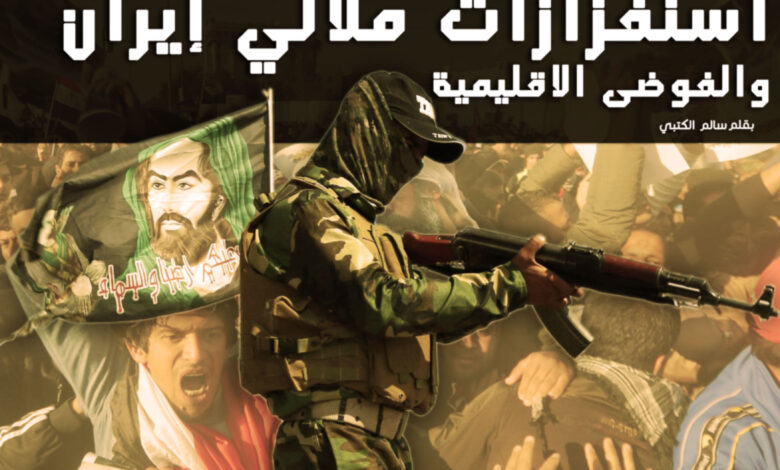
Iran’s plan for the region is summarized in linking terrorism and chaos with whatever is Sunni.
There is no doubt that the burning crisis of the Middle East has produced many lessons, the most important of which is that Iran does not want to build ties with neighboring countries on political grounds but rather seeks to maintain the chaos in order to implement a Persian expansionist project wearing an ugly sectarian mask. And the other lesson in my opinion, is that Iran is betting on driving a wedge between the Arab States and their citizens who belong to the Shiite sect, as it seems that Iran is investing a lot of its political, media and military resources and energies in driving a wedge between the Sunni Arabs and their siblings from Shiite Arabs, and strives to break down a long historic heritage of peaceful coexistence among sects, and resorts to blowing in the fire of sectarian sedition through false claims of defending what it falsely calls the oppressed in several Arab countries!
Probably, a researcher in Iranian affairs would not find a single incident proving that Iran takes the defense of religion as a principle in its political behaviors. It makes a lot of noise day and night against the “occupation of the Zionist usurper” and uses other empty slogans, but has not directed the guns of its regional Shiite militia and proxies except to the chests of their fellow Sunni Arabs in Iraq and Syria. Add to that the fact that Iran’s stances in several international crises reflect its total disregard for religious unity in its political orientations, and a proof of that is the Nagorno-Karabakh crisis and others, as well as Iran’s hostility to everything that is Sunni in the Middle East and, indeed, it seeks aggressively to discredit the Sunnis in the Muslim world and tries to link them to terrorism in an unfair and aggressive way, whether by the media machine of Iran, or through the strengthening of terrorist organizations attributed to the Sunni Islam, such as “Al-Qaeda”, whose leaders were hosted by Iran for many years, then “Daash”, which several intelligence reports indicate that Iranian Revolutionary Guards’ laboratories contributed strongly to the emergence of the organization and its expansion in order to find a pretext to intervene in Iraq and Syria, and to expand the influence of Tehran and achieve its dream of Persian expansion.
I think that the practices and behavior of the Iranian regime currently are not far from the international plans and conspiracies of division, there is even evidence and indicators on positions coordination in light of what is said years ago in the research corridors of the US about an alliance with the Shiites at the expense of the Sunnis, a trend that is fueled by some known American researchers of Iranian origin. Iran is implicitly allied with ideas and projects for the division of the Arab region based on sectarian lines, beginning with the 1982 plan of “Oded Lennon”, the former Israeli Prime Minister Ariel Sharon’s adviser, aimed at promoting sectarian and ethnic conflicts in the Arab countries and raising the Shiite Sunni conflict in particular, which is the same ideology from which the plan of “Bernard Lewis in 1992” was launched, which also spoke about the division of the Arab region along sectarian, religious and ethnic lines. Then the American officer Ralph Peters’ plan dubbed “2006 blood borders”, which was more explicit and detailed in talking about sectarian lines to divide the region. Those who think that Iran rejects these conspiratorial projects are mistaken. Iran’s primary objective is in the first phase to set up several Shiite Arab states, in a move designed to restore the glory of the Persian Empire that the mullahs of Qom dream about!
If the existing division plans on blood borders stir the evil desires of Daash and Persians alike, and refer to several Shiite Arab countries, the planned expansion of Iran aims to establish a Shiite State in Iraq, and another Alaouite Shiite State in Syria, which is exactly what Tehran seeks to currently achieve in the crisis of Syria, as it is working hard to offload Damascus with its western and northern countryside in addition to Homs and its countryside all the way to Latakia and Tartous and the entire coastline, of the Sunni Muslim population and to replace it with Syrian Shiites as well as Shiite fighters from Iran itself, Pakistan, Afghanistan and Iraq.
This is part of Iran’s plan, and the other part concerns the GCC countries, particularly Saudi Arabia, where Tehran is seeking to ignite the fire of strife between Sunnis and their Shiite brothers in the GCC countries, especially Saudi Arabia, Bahrain and Kuwait, which offers to Tehran a strong ability to exert pressure on these countries, as that obnoxious sectarian crises in these countries, God forbid, would be far away from Iran, which means that it would spark a conflict outside its borders, which would also be managed by proxy, as is happening in Iraq, Syria, Lebanon and Yemen.
The continuous Iranian provocations to Saudi Arabia are in their essence and purpose beyond the execution of Nimr Baqir Al-Nimr or another person. Iran executes daily hundreds of its citizens and no one is holding it accountable for that. But the real issue is seeking to drive a wedge between the Sunni and Shiite Arab citizens, and portray this as an ideological struggle, but is in fact a paid conflict that conceals the political ambitions of Iran in the region and its expansion project based on Persian nationalist considerations in the first place.
Citizens of all GCC countries, both Sunni and Shiite, have to line up behind their countries and their leaders. They are in a real historical and citizenship test, and they have to realize that the issue is not related to sectarian conflicts, and that the Sunnis are not targeting the Shiites. There is serious targeting to the Gulf by a serious project of Persian regional Iranian dominance. And everyone should realize that the Sunni-Shiite conflict in any Arab country is in the first place in the interest of Iran and the extremist terrorist organizations falsely attributed to the Sunni sect. And then everyone must pay attention to the lessons of history, which emphasizes that internal sectarian conflicts are among the most serious conflicts that can be experienced by countries and communities, as they lead to fragmentation, and their disastrous consequences continue for decades, and if they explode they would be difficult to control, in addition to the fact that they are among the fiercest wars, because they relate to beliefs and sanctities.