The repercussions of the current conflict between Saudi Arabia and Iran are still emerging, and even more is expected to come on the scene in the near future. In fact, this is just another episode in the endless rivalry between the two countries. Actually, nothing was new in Iran’s stance; however, what was chokingly new to me is the wrong interpretation given by a number of Arab observers, who bought the Iranian story. Seemingly, they have not taken into consideration the reasons behind Iran’s moves and have not managed to analyze its positions and reactions in the light of its precedents and extremist ideological beliefs, which largely shape its policies and positions.
Some Arab media and analysts have argued that the Iranians have shown some “good faith” actions and aimed at satisfying the Saudis by officially apologizing for the attack on their diplomatic premises.
Arguments like these are pitiful and annoying in the same time, because they clearly show how weak and misleading is the analysis provided and promoted by such analysts, who we presuppose act in “good faith”.
Before analyzing anything about the region, an analyst needs to clearly see the whole picture and to be aware enough of Iran’s typical expertise and ability to manoeuver and deceive. What Arab people read, hear and watch about the Iranian reactions after the assault does not really reflect its real position. In fact, Iran has adopted a set of media and political tactics to achieve two goals:
First, to defame Saudi Arabia and its allies and to picture them as the aggressing party who does not want peace.
Second, to win over the international public opinion and absorb the storm of denunciations, before playing the innocent through a set of well-designed media tactics.
The Iranian propaganda was very active after the assault, especially on social media, and may be those analysts were affected by such poisoning propaganda. “Iran has officially apologized for what happened to the Saudi embassy, so what do the Saudis have to do in response?” This is one example of the online Iranian propaganda which tries to kill the truth and deny the kingdom’s right to firmly defend its sovereignty and its nationals. Iran has apologized, no one can argue about that, but to whom? Instead of apologizing to its victim, which is obviously Saudi Arabia, it has sent a letter to the UN Security Council regretting the aggression and promising that it will not happen in the future.
But why apologizing to the UN Security Council? Apparently there are two reasons. First, the council has firmly condemned the attack on Saudi diplomatic compounds. Second, the council is about to discuss the violation of its Resolution N° 1929 prohibiting Iran from undertaking any activity related to ballistic missiles that can be used in a nuclear weapon, after testing the long tom missile “Imad” in the few last months. Apparently, Iran is trying to avoid any UNSC doubts or negative assessment of its implicit wicked intentions towards its neighbors and international peace, especially after reaching a final agreement on its nuclear program with the great powers.
This letter and all the other Iranian moves that follow the barbaric assault on the embassy of Saudi Arabia had one main goal: absorbing the negative consequences of the attack that revived the grim picture of Iran during the seventies. At that time, Iran reached the peak of its revolutionary convulsions, which resulted in a series of horrible attacks on different diplomatic premises where hundreds of foreign diplomats and nationals were detained as hostages. The most evident example to cite here is the assault on the US embassy in Tehran, in which 52 American nationals were detained as hostages for 444 days (from 4 February 1979 until 20 January 1981). Recalling these barbaric acts disconcert Iran, because they expose the Iranian wolf hiding in sheep’s clothing. May be the leaders in the “Army of the Guardians of the Islamic Revolution” did not take this into consideration while preparing their attack on the Saudi Embassy; However, it is quite sure that they intended to embarrass their rival President Hassan Rouhani in front of the international community.
Iranian devil wit does not neglect anything no matter how small it is to play the innocent and depict itself as a peaceful state. Right after the execution of the Shiite religious scholar Nimr AL-Nimr by Saudi Arabia, Iran renamed the street hosting the Saudi embassy after Al-Nimr. Surprisingly, few days later, the street restored its old name. Besides, the Iranian authorities dismissed a security official as a very small scape goat. It has also taken a number of insignificant measures whose real aim is pretty clear to any analyst closely following the latest development: deceivingly marketing the image of a peaceful and cooperative Iran.
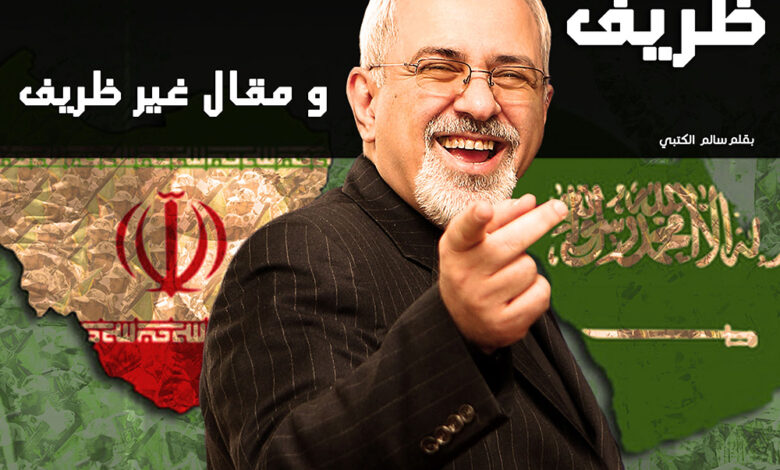
The next step in Iran’s plan is to move from a defensive position to an offensive one. One aspect of this change is Iran Foreign Affairs Minister Mohammad Javad Zarif’s article published by “New York Times”, in which he criticizes Saudi Arabia and reverses facts. Personally, two elements catch my attention:
First, the publishing entity is a well-established American newspaper that has always played an influential role in the Iranian-American bilateral relationships. “New York Times”, which has received about 131 Pulitzer Prizes, and is very well known for its firm support for Israel. So publishing the article of an Iranian senior official whose country threatens Israel day and night means that something is amiss.
Second, the relation that Zarif’s article establishes between reaching a final agreement on his country’s nuclear program and the fight against terrorism. He said “All parties hoped, and continue to believe, that the resolution of the nuclear issue would enable us to focus on the serious challenge of extremism that is ravaging our region — and the world.
The minister wasted no time before launching his reckless and explicit attack on Saudi Arabia by arguing that “Saudi Arabia began devoting its resources to defeating the deal, driven by fear that its contrived Iranophobia was crumbling”. Zarif, who proves to be wrongly named one day after another (“Zarif” means “nice” in Arabic), carried on his attack by “denouncing” the execution of 47 prisoners in Saudi Arabia with the sword, including the Shiite religious scholar Nimr AL-Nimr. He focused in his article on the word “sword” to deceitfully create a connection between the executions carried out in Saudi Arabia and those carried out by IS to subconsciously instill hatred of the kingdom into the hearts of Americans. He also said that there is no difference between “IS sword terrorism” and “Saudi sword terrorism”, which killed the “peaceful civil militant” Nimr Al-Nimr. This could be the funniest joke ever said by the most unpleasant person.
After the few lines in which he mentioned his government’s denunciation of what happened to theSaudi diplomatic compounds, the Iranian Foreign Affairs Minister convicted Saudi Arabia of provoking his country and reopened the issue of Hajj stampede in which hundreds of Iranians were killed. And this clearly shows that Zarif mixes everything up by creating an illogical association between the attack on Saudi diplomatic compounds and Hajj stampede, which are two different issues.
In a threatening tone, Zarif shamelessly said that the Saudis and their allies “… can continue supporting extremists and promoting sectarian hatred; or they can opt to play a constructive role in promoting regional stability…” hoping “…that reason will prevail.” For me, we cannot expect something else from a guy fond of lying and reversing facts
This is the peaceful Iran which seeks good neighborliness: It instigates the world against its neighbors and accuses them of atrocious allegations. Not only that, it tries to form a global alignment against them. So what “good faith” actions can Saudi Arabia and the Arab in general engage with this “neighbor”?