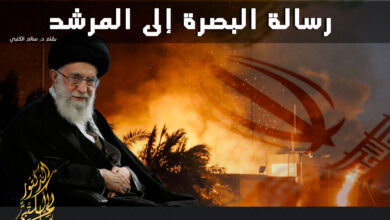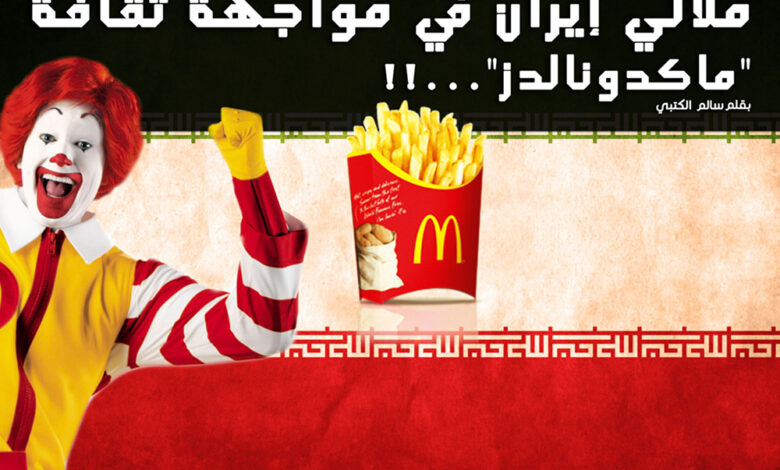
Iran’s Presidency Assembly of Experts member Ahmad Khatami was quoted as saying that the United States is “trying to infiltrate Iran through sandwich restaurants like McDonald’s,” and that “America uses McDonald’s and sandwiches as opening gaps for entry”, ISNA cited.
Khatami was speaking in front of a large crowd of Basij troops and he considered that Iran’s leaders know the “truth” but some fear saying it and that only Supreme Leader Ali Khamenei spoke it.
What Ahmad Khatami said in this regard has already been repeated by Supreme Leader Ali Khamenei but in different contexts when he warned of a “cultural invasion” and “American infiltration”. The representative of Khamenei in the Iranian Revolutionary Guard, Ali Saeedi, also referred to the idea of American infiltration through McDonald’s saying that “a cultural transformation and the establishment of McDonald’s restaurants led to the collapse of the Soviet Union.”
We have already discussed in previous articles Iran’s concern with the idea of opening up to the West, and that the Obama administration “sneaks” intellectually to Iran and resorts to the tactics of the Cold War to dismantle the infrastructure of the fossilized ideological systems as it did with the former Soviet Union and that Washington pressured China to open up but Beijing was well prepared for this step and succeeded in containing attempts to infiltrate its system from the inside and developed plans to open up on the global market and take advantage of it to the extent of competing with the US economy.
China has been successful in the era of the late leader Deng Xiaoping who planned the shift from socialism to mixed economy and avoided the mistakes of the former Soviet Union. Deng said that “The biggest mistake of Gorbachev was that he allowed political freedom before the development of his country’s economy.” He modernized the Chinese economy and adopted interim plans for political reform, helped by the Chinese patient mindset.
Therefore, China has engaged aggressively in the global economy, and opened its doors to the famous US restaurants which symbolize the American culture and carry genes of the culture of globalization and the American diligent desire in “modeling” the world disseminating a cultural and civilizational model as a confirmation of the victory of what is known as “the American Empire”. But China benefitted from opening up and never was concerned about hosting some 3500 Kentucky and McDonald’s restaurants more than any other country in the world.
This does not mean that China has assimilated American culture but there is opposition to “global imperialism”. However, these restaurants began in November 1987 and moved on an accelerated pace since the first branch opened in China’s most famous square, the symbolic Tiananmen.
I personally believe that Iran has well studied China’s experience in opening to the United States and fears the consequences if it happened to Iran after the signing of the nuclear deal. Iran is not China with its cultural and civilizational depth. The mullahs are aware that the US soft power is able to dismantle the Iranian theocratic system, and that this system will not hold for long in the face of the “American cultural infiltration”.
China remained for centuries far from Western culture, behind the walls, while Iran was up to 1979 closely linked to Western and American culture in particular. Today the Iranian people feel sweeping nostalgia for the return to openness to the West, as evident from the popular welcome of the nuclear agreement signed recently. Iranians know that this agreement will provide a gateway to the world, while the Iranian regime senses the danger of this agreement and knows it can put an end to its grip on power in the country.
In the case of Iran the situation seems more complex. Iranians looked askance to the desire of American restaurant chains to open branches in Iran, since McDonald’s called for bids for opening its franchise branches in Iran, meaning that the company wants to invest in Iran and that it has future plans for it.
There is no doubt that Iran’s mullahs remember well the scene of thousands of Russians and Chinese in front of the gates of American fast food restaurants. Then, the Iranian regime would be forced at the time to change a lot of the current constants, and will be forced to open the doors in several areas, making maintaining the status quo a matter of deep uncertainty.
Cultural normalization with the United States is the fear of Iran’s mullahs at the present time. The issue here is not about cultural tools to change convictions, but is in the American culture of “hamburger”, which the Iranian regime sees as an imminent danger unlike the Chinese belief that the presence of American food culture in China will not change the nature of the country and its culture.
Perhaps Iran’s mullahs have already escaped from the grave dangers of signing the nuclear deal with major powers, but the agreement itself may open the doors Iran cannot control. Cultural disintegration of ideological systems is a clear challenge to the US, which explains why Iran insists on closing the door to Washington regarding the nuclear issue, which is an option rejected by the West because accepting “the deal” does not necessarily mean the obligation to apply its various clauses.