The Arab countries should read the map of reality and understand the ways of profits and losses for all parties about the Syrian crisis to deal realistically in a way that ensures interests, security, and stability to the Syrian people.
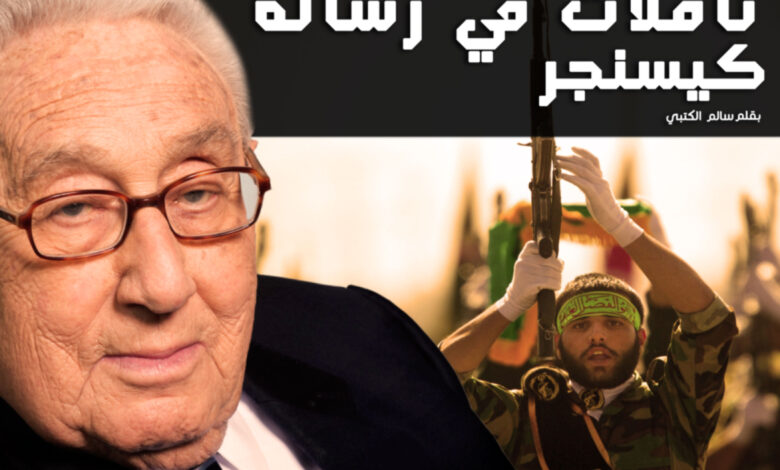
Some days ago, the famous minister of foreign affairs and the ex-advisor of the US national security, Henry Kissinger, wrote an open letter on the newspaper of the Wall Street Journal to the US president Barack Obama talking about the international situations, and about a lot of worthy cases that deserve research and analysis. Henry is well known in US foreign politics nowadays.
Kissinger in his article, warned us all about Daesh, but he considered the ambitions and the colonial plans of Iran more dangerous to the future of the Middle East than Daesh, denying that the openness of the USA towards Iran is similar to openness towards China in the early seventies of the last century, and openness to the former Soviet Union which led to its collapse.
Kissinger, the “architect” of the US openness towards China, sees that the absence of “the Strategic alignment”’ between Iran and his country is a strong sign that the chances to meet between the two is born dead, citing Khamenei’s comments against the US.
Kissinger has sometimes a position which is similar to Arab and foreigner writers who have their own idea about the present from the perspective of the past. There is a huge difference between evoking the past experiences to explain the present and being captured by these experiences. He believes the comments of Khamenei are serious. He takes them into consideration to understand the position of Iran and compare it to the Chinese position in the seventies and eighties, ignoring the conflicts in Iran between the ideological currents which had less impact in the case of the Chinese where the foreign policy was managed in a different way stemming from the ambitions of the Chinese ascending power which are superior to the ambitions and dreams of Iran.
Kissinger may be right about the fact that the strategic alignment between Iran and the USA is absent, unlike Chinese and American relations in the seventies, but the opposite maybe valid too. There are more common things between Tehran and Washington now than there were between Washington and Beijing in the beginning of the historic openness between the two capitals. It seems that he forgot the deep ideological dispute between China and the USA which have two ideological projects and two points of views while Iran is a regional country with an extremist theocratic system. Its power cannot be compared to the power of China and its aspirations during the seventies of the twentieth century.
Perhaps what concerns Kissinger is his focus on content analysis of the political discourse of the Iranian Supreme Leader, pointing to Khamenei’s comments that he refused to open up a dialogue with the United States on files other than the nuclear file, which is a discourse intended for local consumption and to satisfy hard-line mullahs, otherwise we would not find Iranian oil Minister Bijan Zanganeh talking to American oil companies telling them that the Iranian market is open to them, and when asked about the truth of Khamenei’s comments about the lack of dialogue with the US side, on files other than the nuclear file, he did not deny or confirm these statements, because he has the green light by the Vali-e Faqih institution to do so. Everyone knows that the Iranian minister, according to the hierarchical authority and structure of the regime, cannot say anything unless it is approved by the highest decision-maker in the country, Khamenei.
Kissinger spoke of Iranian politicians threats to Israel. He knows before anyone else that Iran and its regional proxies, led by Hezbollah, have become closer to Israel than to other countries in the region, and that the threats made by Iran towards the Gulf States exceed what was directed to Israel a few years ago.
To sum, I think that Kissinger would not be able to convince the American political elite to reject “the Iran and its neighbors file”, which establishes the Iranian convergence with the US and recommends that this convergence will be the beginning of a new phase for the restoration of security and stability in the Middle East, a document which has the support of Americans theorists and experts and known figures that are influential in American strategic decision making; so the Arab and Gulf countries should make strategic calculations in accordance with the new regional realities.
In addition to the above, there is a detail in the letter of Kissinger that is also worthy of attention. It is his expectation that the impact of the Russian intervention in Syria would last for at least four decades which he described a US geopolitical challenge. He considers it the latest manifestation of the disintegration of the US role in the region and a turning point for the region into a state of Chaos. This pessimistic tone primarily concerns US foreign policy. But what matters to us Arabs and in the Gulf, in this detail is the fact that Kissinger diagnosed the Russian intervention in Syria differently than reports and analyses in the media. He thinks what drives Russia is the concern for the consequences of the collapse of the Assad regime and that the Libya scenario would recur in Syria, converting it to a stronghold for terrorism and terrorists, who may tend to expand their operations to the southern Russian border in the Caucasus and other regions. It is believed that Moscow is not interested in the survival of Assad forever, but it primarily seeks to “move the terrorist threat from Russia’s southern border area”, which is a geopolitical maneuver disturbing the American influence.
Perhaps this was a key reason for the undeclared US-Russian understanding in Syria. The disagreement between the two sides on the Russian military intervention seems tactical and does not exceed the strategic principles; so we should not expect the outbreak of a cold or a “hot” war between Washington and Moscow for Syria, because the international and regional environment is completely different from what prevailed in the twentieth century.
Arab and Gulf countries need to read the map again and to understand the accounts of profits and losses for all parties in the Syrian crisis in order to deal realistically and ensure the Syrian people interests, security and stability in the first place, and that the Syrian state would be cohesive and united in the second place.