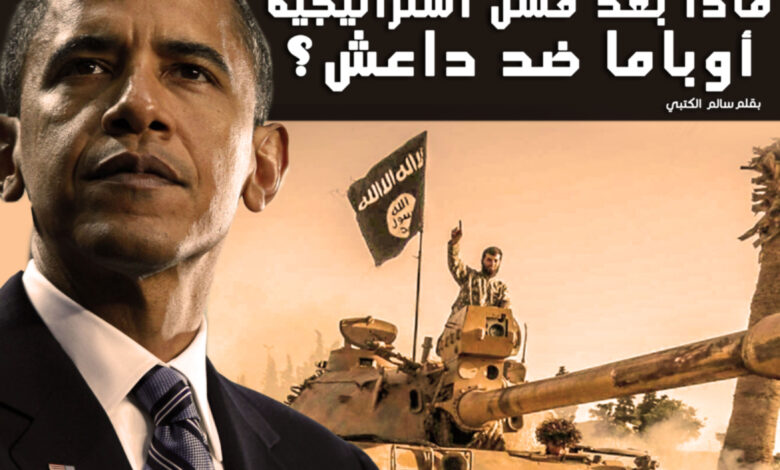
The fact that the Obama administration’s strategy has failed to fight Daesh has been the focus of controversy and deep debate among experts, specialists and researchers. Everyone was surprised by statements by US Central Commander, the top US military commander in the Middle East, Lt. Gen. Lloyd Austin, who said that of the Syrian armed opposition fighters trained by the United States, only four or five fighters are fighting Daesh now. Gen. Austin said in his speech before a US Senate committee that the first 54 out of those who have completed the training program were attacked by al-Qaida militants as soon as they entered Syria in July; some were captured, others killed each other, and the rest fled.
These statements represent the latest evidence that the US president’s strategy failed to defeat Daesh.
The US strategy consists of training moderate Sunni fighters to confront Daesh. The fighters should be chosen the right way or the international coalition may find itself in the face of US-trained combatants.
The issue involves technical, tactical and administrative complexities. The training program was exaggeratedly optimistic. The goal of this 500 million dollar program was training about five thousand fighters annually over three years. So far, only a hundred fighters or so were trained in the first months of the program. It seems that Gen Lloyd Austin wanted to eliminate this program when he announced that it failed.
Reports are talking about dozens of fighters withdrawing from the program because of loyalties conflict. Others of young age joined only for the money, while others were excluded because of physical disabilities. Moreover, it was reported months ago that some fighters who quit the US training program confirmed they did so because American trainers want them to fight against Daesh only, not Bashar al-Assad’s army or any of its agents and allies—including Iranian-backed groups such as the Lebanese Hezbollah militia—and that they had to sign a written commitment before fighting. The US law requires channeling funds as specified by the Congress which agreed to fund training programs to fight Daesh not Bashar al-Assad’s army or the Iranian militias. However, the US government does not want confrontation with Iranian militias, by virtue of the cooperation of both parties in Iraq against Daesh. If trained fighters in Syria attack al-Assad’s army, the US forces operating in Iraq would risk being targeted by Iran’s Revolutionary Guards and the Shiite mobilization forces.
When training plans saw a significant slowdown at first, US Secretary of Defense Ashton Carter said that they were trying to recruit and identify reliable individuals who are unbiased for groups such as Daesh and are willing to fight the organization. But it seems that it was very difficult to identify these people. It looks like the failure was largely expected, as sources in the US Department of Defense announced that the Pentagon has not lost hope in Syrian rebels training programs. They added that there was no shortage of volunteers, but the main problem is that these volunteers were either not capable of fighting or wanted to fight al-Assad not ISIL. He concluded that less than a hundred were trained in this 500 million dollars program.
Obama’s plan to train about five thousand fighters a year to create a Sunni moderate opposition to root out Daesh has failed for now. The United States expects this conflict to continue for no less than ten years, which means that we should expect something more than the failed program. Daesh is gradually turning into a regional catastrophic reality that may prompt countries of the region to engage either militarily or politically.
The future of the fight against Daesh is uncertain. The Arabs, who suffered the most from this group, may not want to await another failure by the US.
They may need to take the initiative to coordinate with the US who leads the international campaign against terrorism in order to achieve more effective, serious and precise military plans in the face of the organization that expands day by day over Syrian and Iraqi territories.