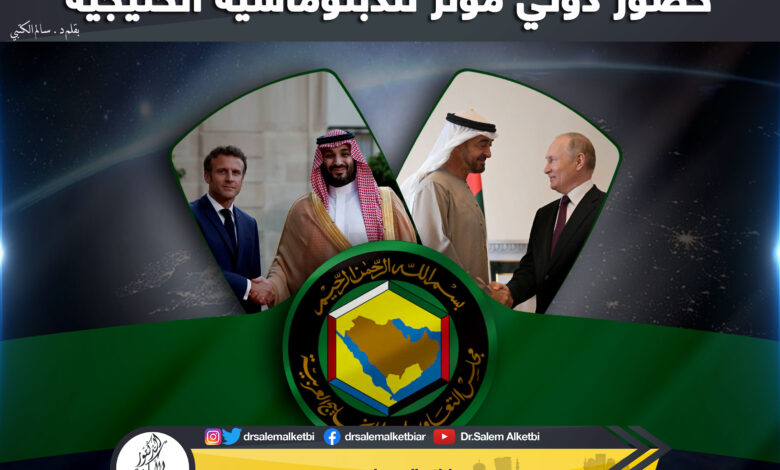
Gulf diplomacy is currently making waves with its active and consecutive regional and international moves. HH Sheikh Mohammed bin Zayed Al Nahyan, the President of the UAE, embarked on an important visit to Russia, followed by a trip to Serbia. In the meantime, Crown Prince Mohammed bin Salman of Saudi Arabia paid a visit to France.
These movements paint a vivid picture of the influential presence and strategic prowess of Gulf diplomacy and its ability to navigate and seize opportunities in its dealings with international allies and partners. They convey the message that the US is no longer the sole dominant player calling the shots in the Gulf region, particularly as these diplomatic actions take place immediately after the visit of the US Secretary of State, Antony Blinken, to the Kingdom of Saudi Arabia, where he met with his counterparts from the Gulf Cooperation Council countries.
The recent visit of Blinken witnessed a notable shift in the tone of the American discourse specifically towards the Kingdom of Saudi Arabia. It implicitly signaled the acceptance of the changes that have taken place in Saudi foreign policy orientations in recent years. The US Secretary of State was eager to showcase the strength of the partnership with Saudi Arabia, despite the evident differences between the two allies on various issues.
In a joint press conference with his Saudi counterpart, Blinken made it clear, “We’re not asking anyone to choose between the US and China,” and went on, “We’re simply trying to demonstrate the benefits of our partnership and the affirmative agenda that we bring.” This a departure from the typical patronizing tone of the American political discourse.
This primarily stems from the strategic assessment carried out by decision-making circles and American institutions, which revealed the difficulty of relinquishing the long-standing partnership advantages with a key ally like the Kingdom of Saudi Arabia. It also underscores that the US would be at a major disadvantage in the intense struggle for dominance and influence against China in the 21st century.
This display of “humility” in presenting the American stance in the face of the strategic challenge posed by China signifies a noteworthy qualitative shift in American strategy and an acknowledgment of accepting divergence in the perspectives of the two allies on various issues. These include relations with Syria, cooperation with China, and the stance on the war in Ukraine, among others.
The aforementioned is a triumph for Saudi diplomacy in reconfiguring its relations with a historical ally like the US. It successfully managed to uphold partnership ties while retaining the Kingdom’s capacity to maneuver and diversify partnerships with other major international powers. This matters particularly considering that Saudi Arabia has become a hub for approximately 26% of China’s overall trade relations and investments in the Middle East region. This highlights the importance of maintaining a delicate balance in order to accomplish the strategic objectives of the Kingdom.
Undoubtedly, Gulf diplomacy operates with exceptional finesse and acumen within its regional and international spheres of influence. The Gulf capitals have become alluring destinations for decision-makers from around the globe, particularly following the easing of tensions with both Iran and Turkey.
Cross-Gulf clash is now highly unlikely, thanks to the strategic maneuvers undertaken by the Gulf capitals to neutralize the potential Iranian threat while safeguarding their own policies and positions, which are closely intertwined with their strategic interests. A notable example is the resumption of relations between Gulf capitals and Tehran, which has not impacted the official cooperation that has recently emerged between some of these capitals and Israel. It is widely believed that there will be no potential ripple effect, as the Gulf approach is grounded in steering clear of a policy of alliances and instead expanding channels of cooperation and establishing connections with all parties involved. This shrewd policy aims to maximize and harness the benefits of regional cooperation to advance ambitious Gulf development projects, such as the Kingdom’s Vision 2030, the UAE’s Vision 2071 and Document of 50’s objectives and principles.
The current Gulf diplomatic movements testify of a seamless adaptation to the shifting international strategic landscape. They serve as sensible responses to the ongoing transformations in the global order, through acquiring alternative options that align with the prevailing reality’s opportunities and challenges. Without a doubt, the new Gulf approaches are no longer merely about reaction to the policies of major powers, even though they may have initially started as such. They swiftly transitioned into the realm of initiative and action, as these countries emerge as active political players.
We are indeed witnessing a new Gulf and a new Middle East. However, what is particularly remarkable this time is that the contours of this new reality did not originate from external sources, nor did they allow major players to shape it according to their strategic visions. Instead, this strategic reengineering was accomplished through a different scenario crafted by the new regional actors, such as the Kingdom of Saudi Arabia and the UAE.
Furthermore, we are witnessing novel Gulf diplomatic strategies that prioritize agile and adaptable responses to changes, veering away from rigid templates that have governed the foreign policies of the region’s countries for decades. This shift is evident in overt stances, such as fostering closer ties with China, the decision for Syria to rejoin the Arab League, the resumption of relations with Iran through direct communication as in the UAE case, and through Chinese mediation as seen in the Saudi case. These developments carry profound implications regarding the transformative changes taking place in both the region and the globe.