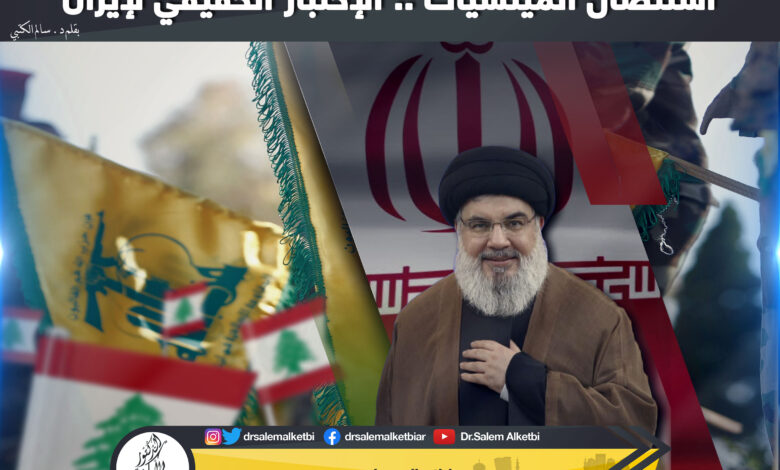
It is concerning to learn that a Lebanese security official has recently relayed a message from Hezbollah’s leader, Hassan Nasrallah, to the US mediator in Lebanese-Israeli border demarcation talks, cautioning of an all-out war that would “destroy Israel and half the region” and that plans for the war were fully prepared.
This warning reveals the reality that Iran-backed militias remain the principal cause of unrest in the Middle East, irrespective of Iran’s stance towards them. Unless the militias are addressed, the situation in the region will remain unstable.
Although the recent agreement between Saudi Arabia and Iran may suggest a significant shift in the region’s geopolitical landscape, it is essential to acknowledge that the real measure of any Iranian transformation will be reflected in their actions, convictions, and stances, rather than mere rhetoric and declarations. To evaluate any advancement, specific concerns such as Yemen and Lebanon will serve as critical yardsticks.
While it may prove difficult to anticipate a complete overhaul of Iranian policies, especially concerning its militia arms, it remains plausible that a tactical ceasefire or a change in priorities could materialize. However, these arms have been an essential instrument of Iranian foreign policy in recent times and are critical to the regime’s agenda. As a result, it is challenging to envision any significant strides towards Tehran’s relinquishment of these arms without first addressing the underlying objectives it seeks to attain through these instruments.
The staggering figures that have been reported and approximated indicate an enormous outlay by Iran in its backing of militias, whether in Yemen, Lebanon, or Syria. As per Iranian declarations, there is purportedly a proposed allotment of somewhere between 20 to 30 billion dollars aimed at fortifying Iran’s military presence in Syria.
It is an open secret that Hassan Nasrallah openly admits his party’s dependence on Iranian financing for weapons, salaries, and other expenditures, with approximations indicating an annual amount of roughly 700 million dollars. We hold the view that these approximations do not take into account the expense of weapons that are illicitly transported to the party.
Considering the substantial outlay that Iran has made in its backing of militias, it would prove arduous for the regime to relinquish these instruments merely on the grounds of ameliorated relations with Gulf neighbors. These militias serve as the principal mode by which Iran can bargain with the US, the West, and Israel to attain the gains that it seeks to secure.
It is evident that Iranian conduct is fundamentally based on the strategy of waging proxy wars. When debating security and stability in the Middle East, it is untenable to disregard the significance of reinstating national sovereignty and genuine roles to each country in the region.
A key element of reinstating national sovereignty and stability in the Middle East encompasses undertaking resolute measures to counter terrorist organizations and curb their impact in particular countries within the region.
To attain enduring stability in countries such as Lebanon and Yemen, a collective endeavor is needed to terminate the sway of parallel states, where groups like the Houthis and Hezbollah hold sway over decision-making. This, in turn, requires the demobilization of these militias and the dismantlement of their security and authoritarian networks.
The disarmament of the militias that Iran has deployed throughout the Middle East is widely acknowledged as one of the most intricate and delicate issues among the many urgent concerns facing the region.
In order to have a comprehensive discussion on the topic of regional security and stability in the Middle East, it is crucial to acknowledge the significant role played by Iran’s deployed militias in the region. Addressing the issue of disarming these militias is a pressing matter that cannot be overlooked.
Moreover, the notion of establishing a fully functioning nation-state must not remain elusive. When considering regional security and stability, a critical questions surfaces: can Hezbollah’s militia arms be disarmed? Under the current circumstances and for the foreseeable future, achieving the disarmament of Hezbollah’s militia arms is a challenging task.
Hezbollah has emerged as a formidable factor in the Lebanese equation, encompassing political, military, and security dimensions. Speculating the possibility of severing the bond between the Iranian government and Hezbollah seems like a daunting task without a significant transformation that could lead to the end of their affiliation, particularly in military and security terms.
Achieving the desired goal of ending the funding and supplies from Iran to Hezbollah remains tricky under current conditions, even though it could potentially be a means to end the party’s influence. The continued presence and support of Nasrallah, his allies, and their bankrollers mean that Lebanon and the broader region will remain vulnerable to potential threats.