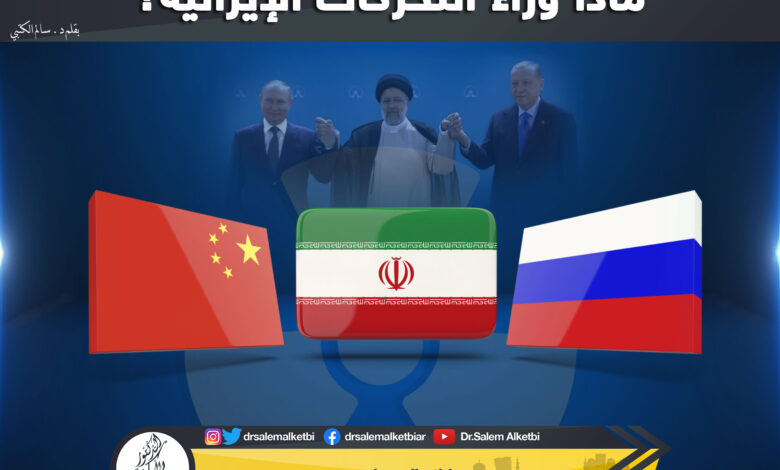
Recently, there has been rapid strategic development at the regional and international levels. Among them is what Ali Akbar Velayati, advisor to Iran’s supreme leader, called the “growing and capable” troika between his country, Russia and China. He said that this troika is capable of countering the “expansionist” tendencies of the US and the West.
Talks about the troika came days after a trilateral summit in Tehran attended by Iranian President Ibrahim Raisi, Turkish President Recep Tayyip Erdogan and Russian President Vladimir Putin. The group image had different connotations in the views of analysts.
But what caught my attention was that German Foreign Minister Annalena Baerbock criticized Turkish President Recep Tayyip Erdogan for appearing in the picture with Russian and Iranian Presidents Vladimir Putin and Ibrahim Raisi. “The fact that the President of Turkey is in this photo is a challenge, to put it politely. This picture is incomprehensible [to] NATO member states,” she said.
Iran is certainly tangibly concerned about President Joe Biden’s Middle East tour. It believes that this tour will lead to a regional security alliance and a military alliance against it. That’s why it has resorted to counterforce and strengthened its position in the face of US pressure, or what some reports describe as a regional defense security structure that Israeli leaders talk about.
This has become a serious problem for the Iranian side, which has been deeply concerned since the signing of the Abraham Accords, which was not meant against it in any way, despite its continued regional inroads that threaten the security and stability of most countries in the region. That’s especially true for the Gulf countries and Israel.
There is no doubt that much of Iran’s recent anxiety is not based on actual facts. There is no regional mobilization against it. The Gulf states and the Arab countries do not want to form alliances to confront it.
But all want to build the foundations of regional security, whether through dialogue with the US or even through dialogue with Iran itself. The reality is also that neither the Jeddah summit was intended to create a Middle East alliance like NATO, nor could the Tehran summit create an alliance between Iran, Russia and Turkey.
The above does not negate the importance of intensified cooperation between Iran and Russia, especially in the economic and trade fields, to the point where Iran could provide Russian military combat drones to fight the conflict in Ukraine, in a shift that has implications worth dwelling on. But we should not go too far in explaining this cooperation and its implications for the Gulf states.
Russia, China and Turkey have larger, deeper and broader interests with regard to the Gulf countries. It is hard to give up these interests for the sake of an alliance with Iran in the face of these countries. One of the goals of Iran’s latest moves is also to try to strengthen its position in the negotiations to revive the nuclear deal.
We are talking about stalled negotiations, in which each side is trying in various ways to harden its stance and get new pressure cards. This explains Iran’s calm tone regarding Turkish policy in Syria. Something the Arabs should pay close attention to.
Syria has become a field for an exchange of interests between regional and international powers. It is a situation in which the Syrian regime needs strong and clear Arab support to maintain Syrian sovereignty and territorial integrity. The above also does not mean that the GCC countries should be left out because of existing ties and interests with China and Russia.
This vast network of strategic interests between the two sides should be buttressed and deepened, and the GCC countries should not make the mistake of the US and depend on the history of their relations with these major powers.
The Gulf capitals must continue on the path they have begun, diversifying their strategic partnerships and working to sign off on these partnerships to secure their strategic interests in the near and long term. New strategic moves on the Middle Eastern chess piece should also be expected in the coming period.
Much of the struggle for hegemony and influence over the world order will take place in our region. This makes the region all the more important. But it requires greater caution and avoidance of mistakes that drive deeper security and political crises in the region.