Indicators of global competitiveness in the 21st century include advanced human development standards, including the representation of women in national parliaments and gender parity in various areas of life. In some parliaments of the world, women represent only 40%. And among the highest percentages (according to World Bank statistics for the year 2017) are for example 48% women parliamentarians in Iceland, 39% in Ethiopia, Spain and Argentina, 42% in Senegal, 44% in Sweden, 43% in Mexico, 40% in Norway, 53% in Bolivia, 42% in South Africa, 61% in Rwanda, 42% in Finland, and 46% in Nicaragua
Many countries around the world are adopting the so-called quota system, which means allocating a percentage of seats to women in Parliament, as a mechanism applied according to specific criteria to ensure the increased presence of women during a period that can be prolonged or reduced depending on the prevailing political culture and consciousness. The countries of the world provide for this system in their constitutions.
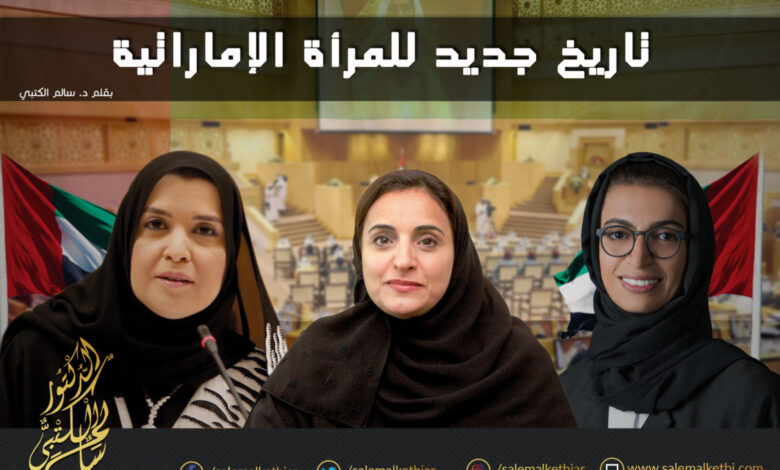
Current indicators of women’s representation in parliament in the UAE are similar to the world average of women’s representation in parliament, which is about 23%. Women’s participation in the Federal National Council in the UAE represents about 22.5% of the total membership. The guidelines of Sheikh Khalifa bin Zayed Al Nahyan, President of the United Arab Emirates, focused on increasing the representation of Emirati women in the Federal National Council to 50% starting from the next session, in order to strengthen the general policies of the State aimed at empowering women, closing the gap between men and women and ensuring gender balance, which has become an important criterion of human development.
These guidelines, which coincide with the UAE’s 47th anniversary celebrations, are part of a qualitative leap in planning for the future through a visionary strategic vision for the UAE 2021 and the UAE’s Centennial Vision 2071, two visions of integrated and evolving development that aims to position the UAE at the forefront of the world, which requires the mobilization of all national human resources, and the promotion of investment in the human element, as a first bet for development, excellence and creativity, and to complete the construction of the Emirati model and dream. The issue is not only about empowering women, but also about empowering society through the empowering of women, said H. H. Sheikh Mohammed Ben Rashid Al Maktoum, vice president and prime minister of the United Arab Emirates and ruler of Dubai. Increasing women’s representation in Parliament is a step in line with the future orientations of the State, and ensures full empowerment of the UAE woman and underlines their active role in development. These measures highlight the confidence of the wise leaders in “Emirates girls”, and test the ability of the UAE women to continue their successes and achievements in the field of work and positions they have assumed.
Strengthening women’s representation will add a new momentum to the Emirati model of development. Emancipation of women in the UAE is not limited to numerical indicators in Parliament and employment, but is an integrated system for the protection and preservation of women’s rights, which is rare at the global level. Global estimates indicate that the world needs 100 years to bridge the gap between men and women. The high representation rates of women in some parliaments of the world does not necessarily mean a good overall situation for women in these countries in terms of gender equality and, more importantly, a legislative structure protecting women’s rights, especially against violence, and guaranteeing their functional rights, in terms of equal pay or otherwise, which represents problems and difficulties that women have encountered so far in many countries.
What reinforces the decision to increase the percentage of women’s representation in parliament up to 50% is that it intervenes a few days after the adoption by the Council of Ministers under the leadership of His Highness Sheikh Mohammed Ben Rashid Al Maktoum, of a set of decisions concerning Emirati women, based on three main axes at the level of legislation and policies, services and international representation of Emirati women, the most important of which is to increase the participation of women in all fields at local and international levels, in particular in diplomatic representation and in State missions to international organizations, and to increase their participation in judicial functions at the level of federal State courts. The new legislation also includes a proposal for a federal law on combating domestic violence, and the study of a set of incentives to increase women’s participation in the business sector, including the elaboration of a national policy for Emirati women entrepreneurship and the establishment of special licensing facilities for women entrepreneurs, and the study of ways in which women can issue licenses and work visas so as to encourage the launching of private enterprises and promote the participation of women in advanced sciences.
It is a new stage in the history of Emirati women and a qualitative leap in the progress of the United Arab Emirates, which boldly tries to respect the norms and requirements of the century, defying everything that happens around the region of which the world knows about its many countries and regions only news of conflict and obscurantist ideas that have drawn a lamentable picture of the Arab and Islamic world.
It is the message of the UAE and its humanitarian and civilizational role to illuminate and dispel the darkness and use all its human resources to carry out the construction of the 21st century dream of the UAE.