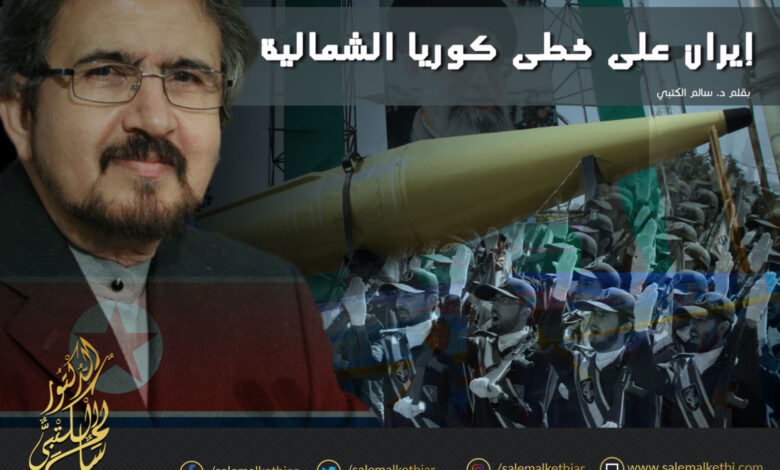
Political and security measures taken by Iran reveal that the country is closely following the North Korean model in dealing with the United States.
The latest evidence of that came from the Iranian Foreign Ministry, who said Iran would respond “strongly” if the United States added the Revolutionary Guards to terrorist lists. The FM said the response would be “crushing” without giving further details.
In the past few years it was usual to sense this sharp tone in the statements of leaders and representatives of the Revolutionary Guard. But this time, it was the Iranian Foreign Ministry who made the fiery speech.
The words came amid unconfirmed reports of a move to put the Revolutionary Guards on terror lists. Days before, President Trump announced his position on the Iranian nuclear deal, suggesting that the mullahs want to “deter” the White House from adopting a strong stance on the agreement and the IRGC.
Iranian Foreign Ministry spokesman Bahram Qasimi said in his remarks that withdrawing confidence from the nuclear deal would be a “strategic error”, calling on President Trump to avoid it. “If they do, Iran’s reaction would be firm, decisive and crushing, and the United States should bear all its consequences.”
The inclusion of the IRGC as a terrorist organization on US lists would be a formidable pressure card on the Iranian regime. It would mean banning all activities of these militias in Iraq and Syria and calling them legitimate targets of the US-led coalition forces in Syria. So far, the US did not add the guards to its terrorism lists and merely listed individuals and groups linked to them as foreign terrorist entities. Imposing US sanctions on “malevolent acts,” as described by the US administration, committed by the Revolutionary Guards in the Middle East will affect the role of their militias in Iraq and Syria.
If they do it, the IRGC “will consider the US armed forces equivalent to the Islamic State, all over the world,” Iranian Revolutionary Guards commander Mohammad Ali Jafari reportedly said, pointing out that the United States will have to transfer its regional military bases i.e. Al Udeid and As Sayliyah bases in Qatar, away from the range of the Revolutionary Guard missiles, that is two thousand kilometers.
The conflict between Iran and the United States has deepened since President Trump addressed the United Nations General Assembly last September, calling Iran a “corrupt dictatorship” and the nuclear deal signed by his predecessor Barack Obama as “embarrassment”. Singling out the Revolutionary Guards may be one of Trump’s options to respond to Iran’s missile tests. The timing of the tests was a huge failure as they coincided with North Korea’s rocket tests, prompting many to relate the two as major provocations in flagrant defiance to the international community.
Besides the escalating rhetoric between the Iranian mullahs and US officials, the most serious indicator so far is the will to classify the Revolutionary Guards Corps as a terrorist organization.
Many analysts doubt the possibility of breaking the nuclear deal with Iran. They see that Congress will not agree to open two fronts of conflict—with Iran and North Korea—at the same time. This is already on the table, but in return Iran could be “sacrificed” to intimidate North Korea. The most disturbing thing to the American side is that the mullahs are totally copying the North Korean style in managing the crisis with the US based on a brinkmanship policy. They presume the United States is not in a position to start a war against a country that has non-conventional military capabilities.
The Iranians risk a lot if they adapt the North Korean mode because the political environment of the crisis is different in both cases. The reasons why the US is not militarily escalating with the North Koreans are completely absent in the Iran case. Tehran relies solely on Russian pressure to prevent a US military strike. This is a non sure deal, though. Moscow may think of entrapping the Americans into a confrontation with Iran.