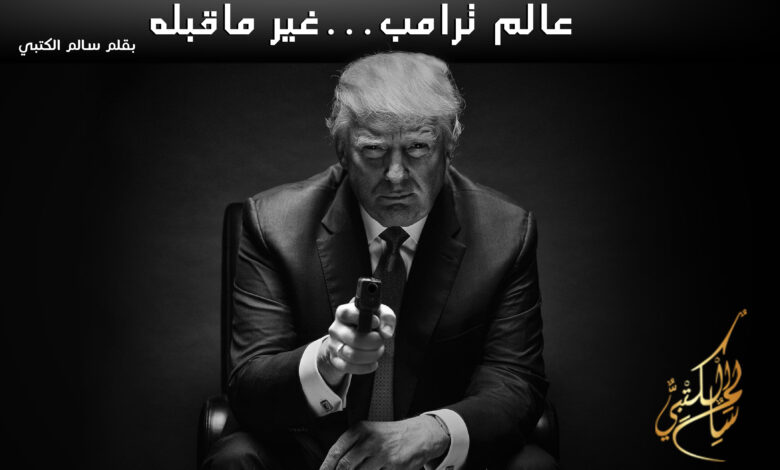
The Arab media and some Western media portray that the world after the twentieth of January next year will be different than before, and that this date, in which the US President-elect Donald Trump officially takes office, will be a decisive point in the history of international relations.
In such perceptions there is some truth and a lot of imagination. President Trump actually differs from his predecessor, President Obama, and adopts a completely different agenda. But this does not mean that he will take US foreign policy in a completely opposite direction, or that he will re-structure it overnight, and that the United States friends would turn into enemies, and vice versa, once President Trump enters the White House.
I was amazed when I read comments by some analysts about the news of the closure by the new American president of some of his companies associated with the Kingdom of Saudi Arabia. They considered that this action reflects a hostile trend, and some even went to affirm that this step is like an imminent preparation for a US Saudi clash!
Such rumors, and I do not say analyzes, because a political analysis must be based on data and specific facts interpreted in light of cumulative experience, political theories and a conscious perception of strategic environment data governing such matters. Those rumors are what is known in the literature as wishful analysis, which has been spread too much in our region over the last years. Many people write what they wish to happen, not what is expected to happen or could happen in the light of the prevailing facts and accurate scientific analysis.
This talk does not mean I monopolize the truth, or that I have the ability to anticipate the new US administration moves more than others, but I’m trying to build an objective position to formulate an Arab vision closer to the truth about the new US administration. We are not talking here about the tendencies of the Democratic Party or the Republican Party, but about the orientations of a president that has a high charisma that separates him from the orientations of the party to which he belongs. We all know that the Republican Party did not provide full or absolute support to President Trump in the presidential election, and some Republican leaders have abandoned him and publicly announced their hostility to his orientations. President Trump also was not elected for being a Republican, but because his views won the admiration of a large segment of the American public. President Obama’s policies, and the orientations of Democratic candidate Hillary Clinton, also played an influential role in the vote for Trump. Therefore, we are not talking about Republican orientations and policies, but about ‘Trumpian’ orientations par excellence, which are hard to put it in the context of the policies of the Republican Party and to be judged in the light of the legacy of former Republican presidents’ policies.
Certainly, President Trump behaves unlike his predecessors and does not adhere to the traditional style of performance of presidents before his term. Therefore, he is expected to be outside the common scope of other presidents after his taking office.
The priorities of President Trump may have begun to take shape. He has initiated contact with the Taiwanese president, sworn enemy of China, declaring a confrontational tendency towards Beijing, asserting in some way the continued interest in the Far East, an interest that begun by President Obama via the “Asia First” strategy, which produced a nuclear agreement with Iran and the decline of the American role in the Middle East issues.
It’s hard for President Trump to politically invest in the Middle East issues, to which his predecessors failed to find effective solutions, especially the Palestinian issue. But he will certainly put terrorism at the top of his interests, and this does not necessarily mean that he will send out US troops to fight Daesh or other terrorist groups on January 21st. But most likely, he will focus on activating the US partners on the ground in the fight against terrorism, and will take more measures related to financial and armament embargo against terrorism.
President Trump would make no effort in the search for solutions to the Palestinian issue. This issue is even expected to witness a period of stagnation that will continue for at least the four years during which the new US president will take over power. As for Iran, it is the preferred file to the new US administration among Middle Eastern countries. It is expected that this file gets great attention from President Trump, but we should not rush into conclusions and predict the probability of the outbreak of a military conflict between the two sides, even if this is in Israel’s interest.
GCC countries in turn will not be directly targeted by President Trump as many expect, or wish, in our region. There is a huge network of strategic interests linking the two sides, and there are several things that stand in the way of risking any clash of interests between the GCC and the US strategic partner, and what is said in this regard is only wishful analyzes as I mentioned at the beginning of my article.
In any case, we are facing a completely different administration from what preceded it, not just the Obama administration, but also the preceding Republican American administrations, and thus we have to wait and see for a while. It is Trump’s world, and its orientations will be controversial not only between the United States and many countries of the world, but also inside the US itself.