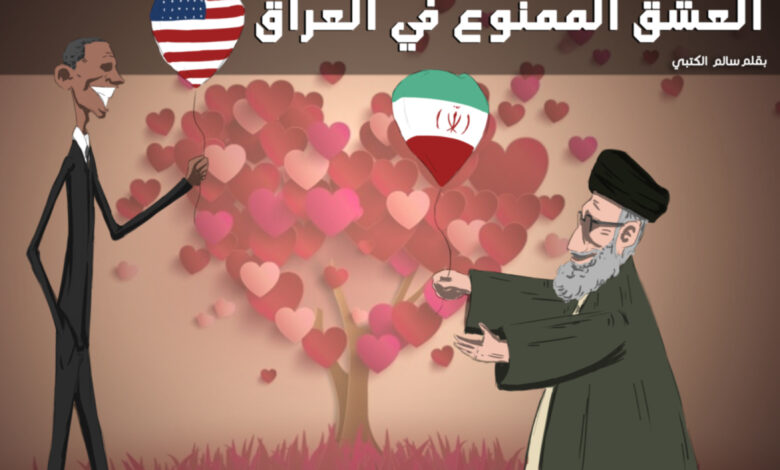
The US administration should understand that Iran’s interference in the region would only bring widespread destruction, especially now that Iran is overtly intensifying its sectarian program.
I am not a fan of the boring Turkish soap operas, but I could not find a better title for this article than ‘Forbidden Love’, the name of the famous Turkish drama series, to capture the political, secret love story that is unfolding in Iraq.
The story goes like this: Bloomberg has recently published a report that the United States share a military base with Iranian forces in Iraq. ‘[t]he U.S. military and Iranian-backed Shiite militias are getting closer and closer in Iraq, even sharing a base, while Iran uses those militias to expand its influence in Iraq and fight alongside the Bashar al-Assad regime in neighboring Syria,’ the article reads.
The article cites senior administration officials saying that the US soldiers and military advisers use a military base in Anbar and that it is ‘the same Iraqi base where President Obama is sending an additional 450 U.S. military personnel to help train the local forces fighting against the Islamic State. Some of the Iran-backed Shiite militias at the base have killed American soldiers in the past.’
The news raise controversy among American observers, given the involvement of the Iranian-backed Shiite militias in killing US soldiers in Iraq in the previous years. Any cooperation with these militias would surprise the US before the Arabs. The US State Dept. even criticized the Iranian support for and the conduct of Iraqi militias, in its annual report on global terrorism for 2014 released last week.
But the Americans fear somethings and the Arabs something else. The US is concerned of the collapse of the fragile alliance between US forces and Shia militias, which would put American soldiers at risk of being attacked by these militias. US experts believe that such cooperation betrays those who fought against the militias during the occupation of Iraq.
the US claims to preserve the unity of Iraq’s territorial integrity, but in the same time, it works with the Shiite militias that made the sectarian cleansing of Sunni populations in the area they retook from Daesh the primary goal of their military operations.
It is true that the American forces do not cooperate with the Shiite militias directly in military training and supply that involves Iran, but these militias get important air support and receive from the Americans information and maps about the ground movement of Daesh. Also, despite the claim that the Popular Mobilization militias do not receive American arms directly, there is a fine line between the Iraqi government forces and these militias, which means that there is no question that they will put their hands on the American weapons. Another thing, military coordination is indispensable in the battlefield, and to say otherwise is to deceive.
The Shiite militia in Iraq is made of sectarian volunteer fighters, ideologically motivated to fight against Daesh and led by Iraqi Hezbollah leader Abu Mahdi Mohandes, known for his strong links with Gen. Qassem Soleimani, commander of the Iranian Quds Force listed by the US as a terrorist organization. These militia groups also include the League of the Righteous, which brutally executed in 2007 five US soldiers in Karbala, and still boasts it today.
Although the political and pragmatic calculations justify the US-Iranian plans for cooperation against Daesh in Iraq, there are alternatives in dealing with such a threat. While this cooperation is present, the United States and the Iraqi government refuse supplying Sunni tribes with weapons in order to fight the battle of their own to expel Daesh of their territories. Washington also took too much time before providing support and assistance to the Kurdish militias in the fight against Daesh, while the Shiite militia enjoys official sponsorship by the Iraqi government, which apparently cannot control these militias.
The Shiite militias in Iraq are as threatening as Daesh; both are non-State actors with abhorrent ideological agendas putting the security, stability and territorial integrity of Iraq in jeopardy.
The White House is also trying to appease Tehran, in every way, offering subtle and unannounced concessions on several regional issues, from Yemen to Iraq, in order to speed pass a final nuclear deal before the thirtieth of June. But the American endeavor cannot guarantee security and stability in the Gulf region and the Middle East.
The US administration should understand that Iran’s interference in the region would only bring widespread destruction, especially now that Iran is overtly intensifying its sectarian program. The Revolutionary Guard brings Afghan, Iraqi, Lebanese and Pakistani fighters to the Arab battlefields and that should be enough for self-proclaimed Sunni, terrorist organizations to bring fighters from all around the world. This is the worst case scenario and the real disaster that everyone is trying to avoid so far in the Arab region.
The US–Iranian forbidden love in Iraq indicates the US does not have good intentions toward the Arab and the Gulf States. The US policy towards the GCC should not be rationalized, it should be modified for the best interest of Washington along its real allies and partners in the GCC, otherwise the Gulf States would seek to diversify their strategic options and protect their interests in the face of the obscure American policy.