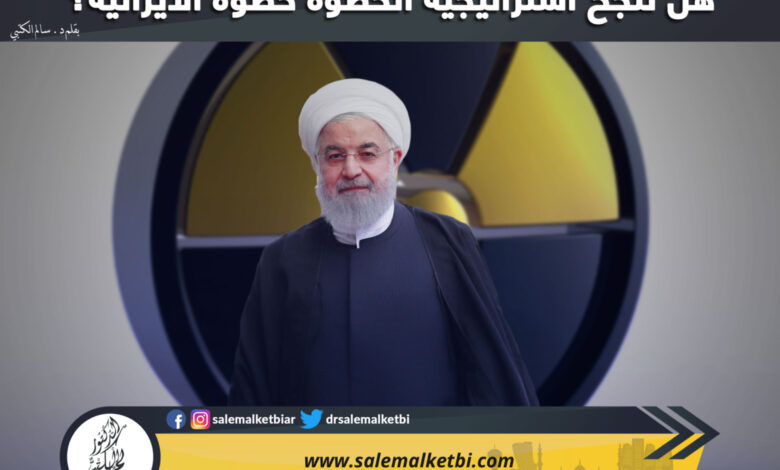
Despite President Hassan Rouhani’s clear and frank refusal of his country’s return to abide by the terms of the nuclear agreement before the United States return to re-engage in the agreement from which former President Donald Trump withdrew in mid-2018, Iranian Foreign Minister Muhammad Javad Zarif has come back to put forward a strategy that can be called the simultaneous return or the “step by step” policy, where he talked about what he described as a compromise solution represented in the simultaneous return of the agreement and its clauses and commitments by the Iranian and American sides, according to gradual steps, that is, a deal in exchange for a concession, and this is how things proceed according to Zarif’s vision and under the auspices of a European mediator.
The truth is that the American response to the Iranian proposal came in the form of implicit rejection, and I think that this matter is convincing for the simple reason that the United States cannot talk about a return to the nuclear agreement before making sure that Iran returns to its obligations contained in this agreement, especially with regard to uranium enrichment rates (3.5%) and ensuring that the quantities of enriched uranium produced during the period of violating the terms of the agreement are disposed of, as well as inspecting the Iranian nuclear facilities to ensure the ceiling of the production capabilities of the centrifuges in those facilities, which is a complex process and is expected to take a time not less than a year. Thus, any American declaration of the start of measures to return to the nuclear agreement is like a free political victory for the mullahs without any compensation for the American side!
It is true that the political mood of the mullahs is tending to harden more than ever due to the harsh insults that the regime was subjected to during the term of President Trump, but logic says that they must show negotiation flexibility, whether with regard to the framework of the planned negotiations, which everyone believes should include regional countries such as the Kingdom of Saudi Arabia and the United Arab Emirates, or by declaring the cessation of violating the terms of the nuclear agreement in order to create a favorable atmosphere and give the American administration the opportunity to take a difficult decision regarding the return to the agreement, especially since this crisis has exhausted many American efforts in the Middle East, and has become so complicated that it is difficult to say that this Return is the key to restoring regional security and stability.
The reality says that the mullahs are not able to read the signals of the new US administration, and they continued to deal with them – even days ago – as an extension of the administration of former President Barack Obama, until they were surprised by the statements of Anthony Blinken, the new Secretary of State, during which he confirmed his administration’s keenness to consult with its allies before embarking on any step towards the Iranian nuclear file, and he talked about canceling the old agreement and negotiating in order to reach a new agreement with new terms, including the Iranian missile program, the regional role and the militia’s military arms of the mullahs’ regime. All this means that we are facing an American vision that has almost changed with the change of the master of the White House, and that the change that has occurred is a change in tactics, and this has been clearly evident since the beginning of the election campaign for President Biden, as the objection and criticism was directed at Trump’s strategy and not his goal, and this is what we see now clear. But the mullahs took the analysis in light of wishful thinking and believed that there was a radical transformation that would happen, and that the United States is about to return to President Obama’s approach in dealing with this complex file!
My conviction is that Blinken’s statements indicate a firmer American position than the positions of the Trump administration, as Trump did not talk, for example, about the mullahs being weeks away from acquiring a nuclear weapon, and this statement in itself is very important not because it obligates the American administration to take serious political action to stop this imminent danger to its interests and its allies, but because the new minister was not obliged to this, especially at the beginning of the assumption of responsibility, but it seems that he wanted to put the European allies before their responsibilities and play a major role in pressuring the mullahs and deal early with any Russian or Chinese support for the Iranian side on the nuclear deal issue. And perhaps, Blinken also wanted to increase the pressure on the mullahs, given that his declared assessment of the danger represents in one dimensions a “green light” that Israel – if it wanted – could use to launch a surprise military strike against the Iranian nuclear facilities, especially since the Israeli side has crossed the threshold of the media threat and is discussing this scenario officially and openly at the governmental and military levels, to the extent that the security cabinet held a meeting devoted to discussing the Iranian nuclear file.
It is clear that the mullahs do not want to appear retreating and are seeking from the beginning to obtain a political victory in the event that the United States returns to the agreement unconditionally, but President Biden, on the other hand, cannot take such a step in light of this divided internal environment, and he also needs to take decisions that prove restoring the prestige of the United States globally, not the opposite, and thus the situation remains secret, awaiting an effective breakthrough by one of the parties concerned with the crisis, and this is unlikely, at least in light of the current data.