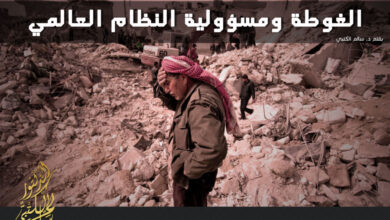
The Arab body has suffered many wounds and crises since the 2011 unrest. The mere fact of talking about Arab collective security, national security and the unity of the Arab class has become debatable. Internal conflicts and external interventions have damaged the social and national fabric of some Arab societies and entrenched sectarian and political divisions and differences among the people of the same people.
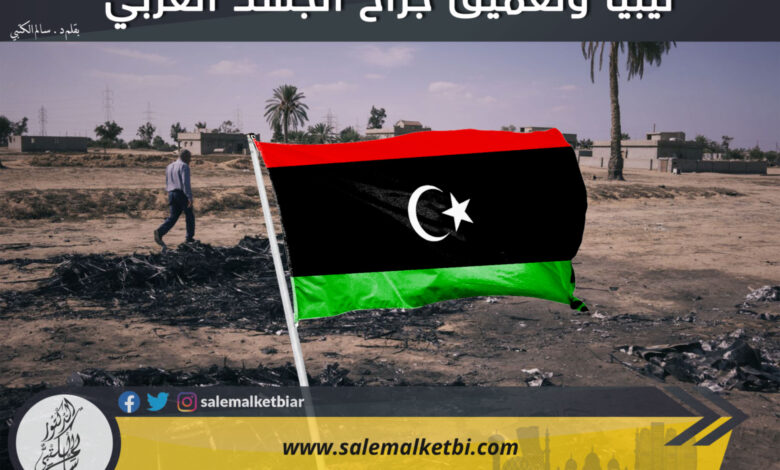
Despite what is happening in Yemen, Syria, Iraq and Libya, and the blatant Iranian interference that has contributed to, or rather provoked, the crises in some Arab countries, the adventure that the Turkish regime intends to undertake in Libya will be a new catastrophe that will affect our Arab world.
President Erdogan made a military intervention in Syria. It found no one to stop him, either because of the divergent interests of the major international powers, or because of the weariness of the Arab system of collective action and its weak capacity to build a strong position against the Turkish project.
Erdogan’s military intervention will provoke a new catastrophe for an Arab country bogged down in conflicts that have been going on for many years.
There is no doubt that the intervention of Turkish forces in Libya to support the Al-Sarraj government against the Libyan National Army does not only herald the outbreak of a large-scale regional war. But it also threatens to attract all armed terrorist organizations from all sides to make Libya a new gathering point. Libya, with its natural resources and wealth, could become a coveted ambition for these organizations, which lost their sources of income with the collapse of their so-called caliphate in Syria and Iraq.
President Erdogan wants to create a new regional reality in which Turkey will have a major dominant role. He competes with that of the mullahs’ regime, which expanded in many Arab countries, and even boasted at some point the control of history-old Arab capitals such as Baghdad, Damascus, and Sanaa.
The Turkish sultan who dreams of glory to his ancestors wants his country to have a new role in the war-torn Arab countries. We saw how he intervened in Syria to control part of his land by calling for the creation of a security zone for refugees. Now here he is intervening in Libya, about two thousand kilometres from the Turkish border, allegedly to protect the Sarraj government and Libyan citizens of Turkish origin.
Fayez al-Sarraj, head of the Tripoli government, went wrong when he ignored reality and geostrategic calculations and aligned and allied with Turkey under the guise of a memorandum of understanding. The document he signed with President Erdogan opened the door wide to Turkish military intervention.
He also made the mistake of ignoring the will of the Libyan people, who have paid dearly for the defence of their land against invaders and settlers throughout history.
A third mistake was to ignore the lessons and consequences of the actions of the Houthis in Yemen, who allied themselves with Iranian mullahs at the expense of the Yemeni people, and ignored the interests of major regional powers such as Saudi Arabia and the rest of the GCC Because of Houthi’s intransigence and his insistence on an alliance with Iran at the expense of the interests of the Yemeni people, Yemen saw nothing but crises.
Al-Sarraj was also mistaken when he believed that the convocation of Turkish military support would pass unnoticed by the major powers like US, Russia, France, and Italy and that a regional major power like Egypt could accept the presence of a Turkish military on its borders.
A Turkish military intervention in Libya, if it were to take place, would be a new catastrophe that would hit the Arab body hard. It would require a recovery commensurate with the scale and results of this new disaster.
Libya is not a Turkish colony. The Libyan people have not asked for help from Sultan Erdogan, who claims to protect around one million Libyans of Turkish origin.
In order to seriously address this looming crisis, a serious practical and realistic collective Arab stance is now required to tackle Turkey’s direct military intervention in Libya.
What is also needed is a joint and effective political and diplomatic role for Libya’s three neighbours most closely linked to the consequences of an escalation of the military conflict in Libya, i.e. Egypt, Algeria and Tunisia—the Arab parties most affected by events on the Libyan borders.
Of course, this does not mean that the situation in Libya is a private Arab affair. Rather, it is a question that affects the entire international community.
Libya is geographically relevant to the EU, especially since, in addition to the resources and natural assets which Libya possesses and which put it at the centre of everyone’s attention, it is an important gateway for illegal immigration.
Supporting the collective Arab position is an international responsibility to rein in the Turkish Sultan and prevent him from triggering a regional conflict that will be paid for by everyone in the Arab region and beyond.