Many researchers traditionally argued that the Europeans are more familiar with and understanding of what goes on in the Middle East than the Americans, given their colonial past and historical relations with the people of the region.
This argument is valid in some cases, but in others, we fail to understand the dimensions and motives of European position-taking on given regional issues. Relations with Iran are a good example of the limits of European understanding of the tensions, chaos and turmoil in the Middle East.
The Iranian violations of the deal trouble the Europeans who, nonetheless, are concerned about the President Trump’s stance against the 2015 nuclear accord signed with Iran. The US President has not agreed that Iran was committed to the terms of this agreement.
Iran for its part encouraged the Europeans by promising more economic and trade deals, in exchange of the EU’s objection to “bad practices which disturb peace and international cooperation,” to quote President Rouhani.
The Europeans fear wasting years of negotiation with and reimposing sanctions on Iran, thus wasting opportunities for dialogue to convince Tehran to abandon its arms ambitions. But the diplomatic approach does not work in this case.
Keeping the doors open and communication channels are fundamental in international diplomacy, but only if the parties share a mutual desire to seek solutions. Otherwise diplomacy opens doors to blackmail, wringing concessions and an opportunity to gain time and to achieve the goals of a subversive party.
Speaking about the American approach, one European official said many in the world will think about whether they should possess nuclear weapons themselves, if such agreements fail, “And then our children and grandchildren will grow up in a very dangerous world.” If the United States discredits the agreement or imposes new sanctions on Iran, the conservatives in Tehran will have the upper hand as they would find an excuse to oppose negotiating with the West. They will start developing nuclear weapons, which Israel would not tolerate and which would put the security and stability of US ally countries at risk for local political reasons, the official explained.
But these assumptions are unfounded for several reasons. First, breaking the nuclear deal will happen because Iran was violating the spirit of the deal; arms agreements are generally founded on serious intentions to achieve security and stability and defuse tensions. For a signatory to search for loopholes to pursue the same objective that the agreement was meant to prevent is unbecoming for States that abide by the legitimate decisions adopted by all UN member States. Second, the Europeans assume that there are moderates and hard-liners in the Iranian regime, a historical illusion the mullahs of Iran managed to maintain. Europe fears that canceling the agreement would lead to the rise of hard-liners in Iran and thus losing opportunities to negotiate with the West. On this level, the Europeans do not understand well Iran’s political strategies.
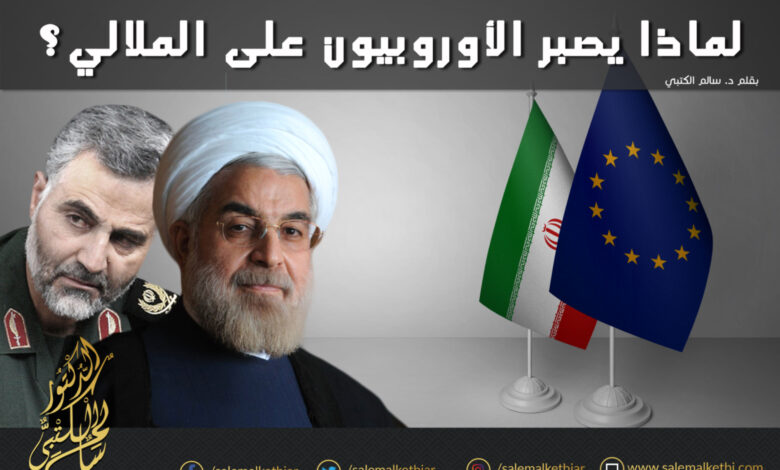
The “moderate” president Hassan Rouhani said that his country maintained the production of “all ‘defensive’ weapons,” speaking for the hardliners and radicals in the IRGC.
Rouhani, Gen. Soleimani and others do not speak for themselves when they express positions on regional and international issues. No. They speak for the man who sits on top of the regime, the master puppeteer. He distributes hardliner and moderate roles according to time, conditions and strategic issues. No personal positions or different views about this issue or that crisis.
Do Europeans not know that? On some level, they do. However, they still bet on options that are proved to fail. The policy of containment and using the time factor in resolving crises make up the European strategy, but the United States has tried this before, not achieving significant results. The EU approach is disastrous because it helps Iran expand its influence in the Middle East, after it finally found an opportunity to reach the waters of the Mediterranean through Iraqi, Syrian and Lebanese territories. If that happens, it will involve massive shifts in regional security and economic and strategic interests of all the countries in the region.
Many Europeans accuse President Trump of not knowing the context of the conflict of the Middle East and holding positions that are very different from those of former Presidents Clinton and Obama. But as a matter of fact, all tactics that were previously used with Iran failed. Even worse, Iran is starting to follow the North Korean model.
The Iranians will not change their attitude unless they realize that balances of power are unfavorable to them and their regime is existentially threatened. We must believe that the interests of this system are its top priority. That’s why in the 2003 Iraq war, in 2001, and the US bombing of the Taliban, where they totally cooperated with the US out of fear, they showed their “nice” face.
In crisis management, you always need to figure out the psychological frame of the other party.