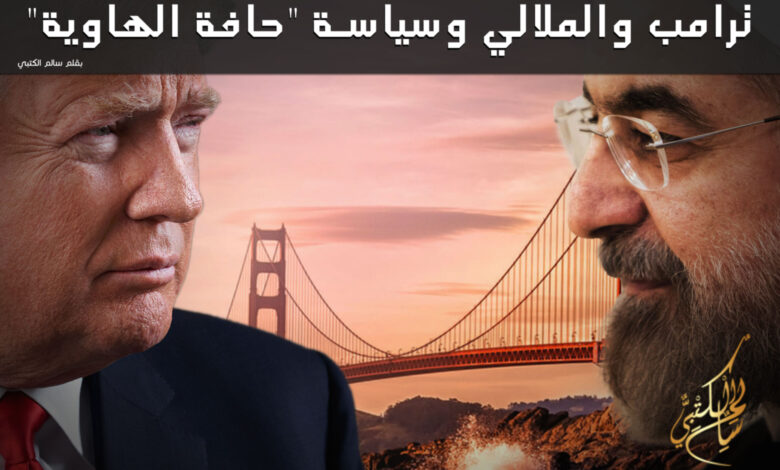
The whole world is following the escalation of political discourse and mutual threats between the theocratic regime in Iran and US President Donald Trump. The threat seems similar to the Cold War.
Escalation is sensed in the tone of the conversation. President Trump warned on Friday, February 13, his Iranian counterpart who said that anyone who threatens the Iranians will regret it. Trump answered “better be careful.”
Some observers like comparing the Cold War to the US-Iranian relations, but there are aspects of profound differences between the two cases. The mullahs are not experienced in statesmanship like Nikita Khrushchev, nor is Trump quiet and experienced like John F. Kennedy. The capacity difference, both in the balance of military forces or international influence between Iran and the United States now does not help the escalating crisis. There is an enormous difference between the military capabilities, and this difference is a double-edged weapon; it may either lead the mullahs to go back to reason and logic, or tempt their recklessness and impulsivity under pressure and fear for a sudden blow from the other party.
The Independent considered that Trump will ignite a war with Iran, and that this war is in the interest of Daesh, pointing out that Trump is perhaps inspired by former British Prime Minister Winston Churchill’s policies in 1940 in dealing with Iran. The newspaper draws attention to the fact that Trump is interested in reading history books more than paying attention to current events. The newspaper said that the Middle East has been a battlefield more than any other region in the world and the errors that are committed can be disastrous and irreparable. US President was advised not to work to join the ranks of the Western leaders who have suffered heavy losses because of wrong decisions in the Middle East, noting that these leaders were defeated not due to the military superiority of the other party but for other moral and humanitarian reasons, like what happened to the former British Prime Minister. This brings to mind Carter’s experience in the US hostage crisis in Tehran in 1979, and the US intervention in the Lebanese civil war during the reign of former President Ronald Reagan in 1983.
The Independent spoke of a US military strike on Iran, and this is highly unlikely. The most dangerous problem is the high probability of mutual miscalculation that could lead to the outbreak of a war by mistake, an escalation or a de facto war. Errors in cases of extreme tension can occur, as these almost caused a third world war during the Cuban missile crisis.
The escalation between the mullahs ‘regime and the administration of President Trump was aimed initially to estimate one another. That was clear to the extent that Trump warned the mullahs from testing him. Now previous brinkmanship crises in the relations between the two countries resurfaced. The Iranian regime knows how to deal with such cases, based on a legacy of negotiating experience. The legacy is an a mixture of Iranian ‘carpeting’ skills with experiences of other countries, notably North Korea.
The new US administration is most likely to tighten a new siege on the mullahs’ regime, and this strategy has already begun by prohibiting the entry of Iranian nationals to the United States. Despite the freezing of the embargo judicially, Trump will use other mechanisms, as the administration thinks about listing the Iranian Revolutionary Guards as the first ‘governmental’ foreign terrorist organization. The final decision in this regard will be a strong indicator of future intentions toward Iran, as such a move may accelerate the clash between the two sides due to the strong impact of the Revolutionary Guards in Iranian politics.
Like former American presidents, President Trump did not rule out the military option against Iran. They did not do it anyway for complex reasons and considerations. President Trump differs from his predecessors as he is not good with maneuvering. He is practical and realistic by virtue of his background as a businessman. He may not be too patient about the mullahs’ practices and their continuing violations of international laws and how they try to break the prestige of the United States, as the dominant power in the existing world order. The mullahs will take this into account when dealing with President Trump’s administration.
President Trump is not reckless. It is difficult to anticipate the possibility of dragging him into a war his country does not want. He is certainly rigorous and firm more than his predecessors. The difference between him and his predecessor, former President Obama, is big. The mullahs might miscalculate this difference, and then impose on President Trump a war he does not want, and this is still a possibility.