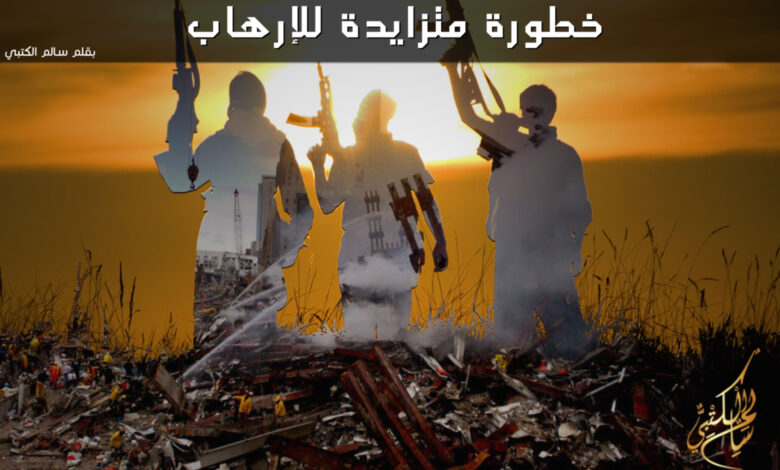
All the evidence, especially as witnessed in several countries in recent times, whether in Egypt or Jordan or Turkey or Germany, confirms that terrorism’s savagery and criminality is increasing, and that the efforts for eradicating it still need to intensify and spread at all levels.
Some experts may believe that the defeat of terrorism in a particular city or region is a sign of its near end, but history experiences regarding this abhorrent phenomenon contain important lessons, among which is the fact that this phenomenon is able to survive in the worst conditions, and it is able to regain strength once it escapes a severe crisis, or a heavy military and security pressure. It is also characterized by a high capacity for alternation between ebb and flow, and more importantly, terrorism leaders are betting on the glow of the idea, and on that it feeds on the efforts aiming at confronting it, and this is the most part of the whole thing, as for how that happens, there is another explanation.
Terrorism leaders are dealing with the military and security strikes against them as a “bonus” or an opportunity they exploit to mobilize sympathy, either through social media, or through traditional tools and channels for mobilization, recruitment and ideological polarization. They employ international campaigns or individual states campaigns against them as a war against religion, and that those who conduct these campaigns are “the enemies of Islam,” even if those are Arab and Islamic countries (!) and other conjectures and lies they promote and which resonate among adolescents and young people because of the weakness of culture, education, and the decline of the role of the legal channels for religious and cultural awareness raising, not to mention other factors supporting this negative atmosphere, such as unemployment, family disintegration and the collapse of values and ethics, and other negative phenomena terrorism feeds on, and exploits in achieving the objectives of the geographical spread and intellectual expansion.
For the second time, the tactic of “running over people” is repeated in the implementation of a terrorist offense in Germany. This tactic is extremely dangerous, because of its simplicity and because it does not need tools to commit a crime. It only requires “charging” the head or the mastermind performing of the criminal act with a certain revengeful idea, and inflaming his religious emotions along with exploiting his ignorance of matters of religion, and the huge vacuum in his knowledge of the bases of true religion, especially among Muslims in Western countries, among whom terrorism organizations and groups have been present for decades, and infused in many of them extremist terrorist ideas that are like time bombs, ready for explosion at any time and any place.
Clearly, the organization Daesh has started using new tools to put pressure on certain international parties in order to influence their political and military positions on the war against terrorism, In this spirit, the recent terrorist crime in Berlin can be explained, as one of elements of the organization attacked a market with a truck, killing 12 people and injuring dozens of others.
The crime of Berlin specifically is not just a cloning of the crime of Nice in France, which was committed by the same tactic. There are differences though. The original truck driver was found shot dead on the chair next to the truck driver. German police sources say he is a Polish citizen, and the police did not find any pistol inside the truck, which means that there is a third party who committed the crime, but certainly it is Daesh which planned the crime, as it claimed so on several Web sites.
In the same way as the driver of Nice’s truck had no direct relationship with organizations of terrorism, it seems that the crime of Berlin will be on a similar degree of ambiguity and it will be difficult to understand what is behind it so as to get to know the modus operandi of the organization and how it penetrates communities and escapes intense security surveillance, especially in periods such as Christmas and so on.
The assassination of the Russian ambassador in Ankara is another new catastrophe that deserves attention. The perpetrator is an element of the anti-riot police, a well-trained element certainly. He easily broke through the security circle of the Ambassador with the help of his personal identity. This raises a lot of lessons and questions at once. How to ensure that terrorism does not break through security circles, and how to be quite sure of the information “update” about the security elements, and not just the initial basic information, which can be subject to change due to the emergence of new variables that have a great impact on beliefs and ideas?
The emotionality that characterized the scream of the terrorist in Ankara meant he was subjected to the effect of a strong compelling intellectual influence that took advantage of what happened in the city of Aleppo to inculcate certain ideas within this young terrorist. Here the matter looks astounding because the person supposed to be an element of protection is the person who commits the crime. This explains the doubtful looks that filled the eyes of the bodyguards of Iran’s Foreign Minister Javad Zarif, towards the Turkish security personnel when the Iranian Minister was in Ankara directly after the assassination.
In summary, terrorism expands and creates new tools and tactics, and the world, with all the development and progress made by mankind at the security and technical level, is still in a position of reaction and prosecution of terrorist crime, and it is difficult to move to the area of action and proactiveness without the adoption of innovative proactive measures for terrorism crime prevention, on the condition of not falling into the trap of fighting religions, as it is noted in the high tone of hostility to Islam in some Western countries. This tone is the renewable kiss of life to terrorism and its organizations.