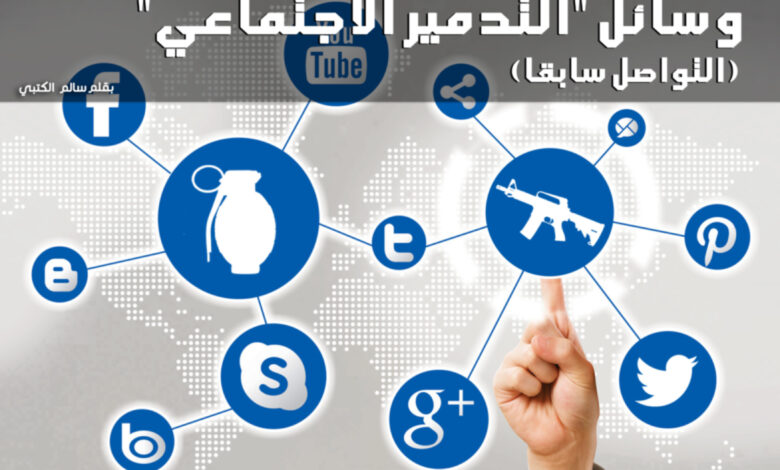
Social networking services spread and were popularized as they enabled millions of people to connect informally, forming the perfect example of a cyber global village. They have globalized and ‘modeled’ our world, in the sense that they succeeded in the making of a unique value model for millions of people—the Western, or rather American, model. From thought, values, customs, to eating habits, dress style and music, this particular model prevailed.
In the Arab context, social networks were effective in igniting protests and unrest in several countries since the end of 2010 until now. They departed from the ‘original’ purpose they claimed, although it seems that using them for political strategic purposes was not unthought-of, at least in the departments specialized in such matters in some Western countries.
I am no conspiracy theorist, but I believe that ruling out this particular point of view to interpret events and attitudes around us is naïve. Certain conspiracy assumptions are key to understand a lot of what is going on in the region and the world.
A link can be established between the so-named ‘academies of change’—that provide lectures and courses for the youth—and the social media that had a big impact in sparking major changes in the region. Large segments of social media users, made up mainly of young people, were mobilized to get down to streets, attracting ‘simple’ people into joining them. Although their movement seemed unorganized and arbitrary, it was not.
Recently, the function of the social media has been shifting from being a scene for exchange of accusations, criticism and sometimes personal insults, into a space for spreading rumors and a powerful social destabilization agent; now, rumors target even the remaining armies of Arab countries. Social media can be far more destructive than they were in late 2010. The number of active users having multiplied, these outlets attracted not just the youth, but also people of different ages, social classes and education backgrounds. The increasing usage has created virtual battles with a huge potential of influence.
Today, anyone can know the situation in any Arab country through a quick overview of the social media trends and posts, especially on Facebook and Twitter (the users of the two services vary by region and uses). The spread of social media occurred after the ‘traditional’ media have become ‘followers’ of online outlets, echoing the materials shared on the internet. Late night talk shows on Arab televisions, for instance, rely aggressively on user-generated content found online.
One of the problems of social media lies in the absence of laws to regulate them, or the difficulty of enforcing such laws, as millions of users go online and offline every hour, with some employing ‘fake’ accounts and other scams. Thus, it sounds unrealistic to try to monitor all this activity.
There are laws regulating the social world in many Arab countries. The UAE, for example, has managed the usage of social media by providing for the protection of users and the society. The Emirates’ strategic vision has anticipated the malevolent usage of social media since 2011. Some other countries did not act to protect themselves from the harms being inflicted to their societies through certain social networking practices.
The negative impact of social media now may not be significant. Nevertheless, it can be perceived as the tip of the iceberg underlying our societies. Facebook and Twitter have turned into means of attempting to spread chaos in some countries and compromise their strategic interests. Some Facebook pages became laboratories of destructive media content and fabricated photo production. Terrorist groups operate in the online media world, as well as government and intelligence agents and experts, all motivated by strategic goals.
I do not hold that preventive measures would be enough to counter cyber plots, as these are only reactive to danger and therefore constantly at risk, every hour of every day.
The stability, security and the future of entire nations must not be left to ‘the boys in the backroom’, nor should they depend on the game of calls for revolutionary waves and tragic escalations which left some Arab countries torn apart while threatening others. The worse is coming, unless real measures are taken.