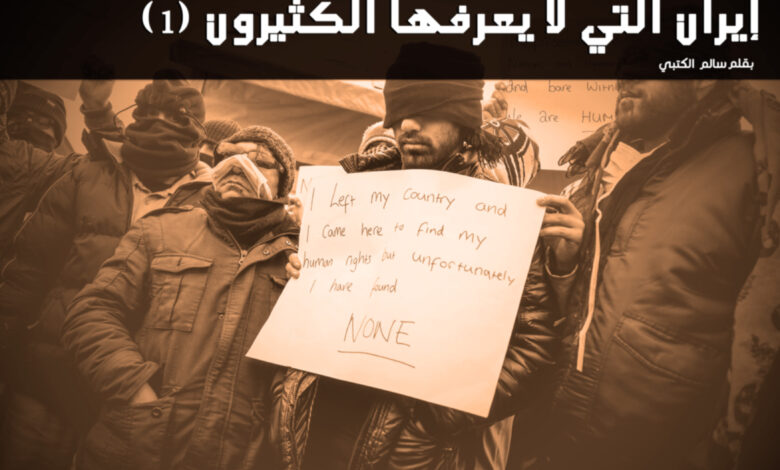
For the Arab audience, the Iranian scene seems quite different from the reality. It might look to them as if Iran does not suffer from internal crises unlike some Arab countries, and that it is a country strong enough to compete with the Arab and International influence in many areas and regional crises.
The truth is, Iran on the inside, is really more fragile and vulnerable than several Arab countries that are generally regarded as fragile according to international standards because these countries are ravaged by the complex internal problems.
At the economic and social level, the Iranian people are facing very serious economic crises as a result of economic sanctions imposed on the country due to hostile practices and policies of the regime towards regional and world countries. Statistics show, for example, that rates of social and family disintegration in Iran reached record-high levels, with divorce rates of 18%, whereas in the sparsely populated and the spiritual Shiite center of Qom province the rate is 13%. According to official statistics, nearly 645 thousand marriages are concluded annually, indicating a worsening socio-economic crisis in the country. Corruption, inflation, bribery, unemployment and moral decline, all resulted from the high rates of poverty affecting – according to official statistics – about 16% of the population, now nearing 80 mil. In a country ranked among world oil producers and exporters, around 4 mil live below the poverty threshold with about $ 70 a month.
There are other complex issues, among which is the worsening environmental conditions that recently spurred large-scale protests in the city of Ahvaz, the capital of the south-western Arabistan/Ahvaz region, where pollution caused an outbreak of pulmonary and heart diseases and a 500% increase in cancer rates in one of the world’s most polluted cities according to United Nations reports. Meanwhile, all the regime seems to be doing is pretending to deal with the crises, as it appointed Masuma Ibtikar as Head of the Environment Protection Organization pretending that this would solve the problem.
The problem in Ahvaz is not just about the environmental disaster, but also ethnocentric and racist oppression. Rich in oil, natural gas and energy sources from the river water, wheat, corn and sugar canes, the province contributes by 80% of Iran’s budget.
Iranian leaders compared Operation Decisive Storm, the operation intended to save the Yemeni people from the oppression of the Houthi group, to practices of the Israeli occupation forces; Iran, however, has engaged in a worse oppressive policy against the Ahwazi Arab people.
To those who do not know, Ahvaz has been an Arab region since the reign of Caliph Omar ibn al-Khattab, and governed by the Companion Abu Musa al-Ash’ari. It is inhabited by an Arab Muslim population of about five million people, and it is an oil-rich province producing nearly 85% of Iran’s total production in oil and gas. It is called Arabstan, Ahvaz and Khuzestan in Persian. It was an Arab Emirate before it was occupied by Persian State during the reign of Reza Shah Pahlavi, who deposed the Arab ruler Sheikh Khazaal Kaabi, occupying the region since 1925. Since then, Iran seeks to obliterate the national identity of the people who is resisting in various ways, but the voice of the people and the historical struggle for over nine decades is kept unheard outside Iran, because of the international and Arab neglect.
The Arab and international communities should not overlook the fair cause of Ahwaz which must be included in the agenda of the League of Arab States and other Arab joint action institutions; it is first and foremost an Arab issue. World organizations must not ignore about five million Arabs who have been prohibited from speaking and learning their native language having a tyranny imposing on them an identity different from their own. Iran is making noise around the world, professing freedom and justice and denouncing oppression while practicing the cruelest kinds of occupation and tyranny against Ahwaz Arab people as everybody is watching. No one to defend the legitimate rights and the identity of this one people.